



NASA Launches New Climate Mission to Study Ocean, Atmosphere
 Tweet
Tweet Share
Share E-mail
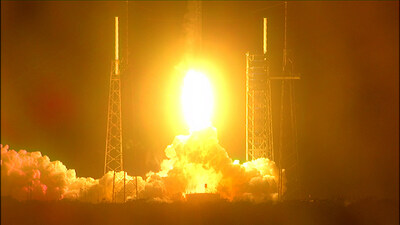
Known as PACE, the Plankton, Aerosol, Climate, ocean Ecosystem satellite launched aboard a SpaceX Falcon 9 rocket from
"Congratulations to the PACE team on a successful launch. With this new addition to NASA's fleet of Earth-observing satellites, PACE will help us learn, like never before, how particles in our atmosphere and our oceans can identify key factors impacting global warming," said NASA Administrator
From hundreds of miles above Earth, the PACE mission will study the impact of tiny, often invisible things: microscopic life in water and microscopic particles in the air.
The satellite's hyperspectral ocean color instrument will allow researchers to measure oceans and other waterbodies across a spectrum of ultraviolet, visible, and near-infrared light. This will enable scientists to track the distribution of phytoplankton and – for the first time from space – identify which communities of these organisms are present on daily, global scales. Scientists and coastal resource managers can use the data to help forecast the health of fisheries, track harmful algal blooms, and identify changes in the marine environment.
The spacecraft also carries two polarimeter instruments, Hyper-Angular Rainbow Polarimeter #2 and Spectro-polarimeter for Planetary Exploration. These will detect how sunlight interacts with particles in the atmosphere, giving researchers new information on atmospheric aerosols and cloud properties, as well as air quality at local, regional, and global scales.
With the combination of the instrument and the polarimeters, PACE will provide insights into the interactions of the ocean and atmosphere, and how a changing climate affects these interactions.
"Observations and scientific research from PACE will profoundly advance our knowledge of the ocean's role in the climate cycle," said
"It's been an honor to work with the PACE team and witness firsthand their dedication and tenacity in overcoming challenges, including the global pandemic, to make this observatory a reality," said
Earth's oceans are responding in many ways to climate change – from sea level rise to marine heat waves to a loss of biodiversity. With PACE, researchers will be able to study climate change's effects on phytoplankton, which play a key role in the global carbon cycle by absorbing carbon dioxide from the atmosphere and converting it into their cellular material. These tiny organisms drive larger aquatic and global ecosystems that provide critical resources for food security, recreation, and the economy.
"After 20 years of thinking about this mission, it's exhilarating to watch it finally realized and to witness its launch. I couldn't be prouder or more appreciative of our PACE team," said
NASA's Launch Services Program, based at the agency's
For more information on PACE, visit: https://www.nasa.gov/pace

 View original content to download multimedia:https://www.prnewswire.com/news-releases/nasa-launches-new-climate-mission-to-study-ocean-atmosphere-302057268.html
SOURCE NASA
Serious News for Serious Traders! Try StreetInsider.com Premium Free!
You May Also Be Interested In
- RoboParty Unveils RP1, a High-Performance Full-Stack Open-Source Humanoid Robot at IROS
- Govee Turns Up the Spooky With Sarah Michelle Gellar in New Nationwide Halloween Campaign
- Cindi Love Announces Opportunity Architects Framework to Redesign Leadership and Learning in the Age of AI
Create E-mail Alert Related Categories
PRNewswire, Press ReleasesRelated Entities
Definitive AgreementSign up for StreetInsider Free!
Receive full access to all new and archived articles, unlimited portfolio tracking, e-mail alerts, custom newswires and RSS feeds - and more!
