



NASA Analysis Confirms 2023 as Warmest Year on Record
 Tweet
Tweet Share
Share E-mail
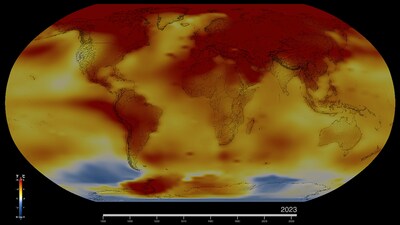
"NASA and NOAA's global temperature report confirms what billions of people around the world experienced last year; we are facing a climate crisis," said NASA Administrator
In 2023, hundreds of millions of people around the world experienced extreme heat, and each month from June through December set a global record for the respective month. July was the hottest month ever recorded. Overall, Earth was about 2.5 degrees Fahrenheit (or about 1.4 degrees Celsius) warmer in 2023 than the late 19th-century average, when modern record-keeping began.
"The exceptional warming that we're experiencing is not something we've seen before in human history," said
Though scientists have conclusive evidence that the planet's long-term warming trend is driven by human activity, they still examine other phenomena that can affect yearly or multi-year changes in climate such as El Niño, aerosols and pollution, and volcanic eruptions.
Typically, the largest source of year-to-year variability is the El Niño – Southern Oscillation ocean climate pattern in the
However, the record temperatures in the second half of 2023 occurred before the peak of the current El Niño event. Scientists expect to see the biggest impacts of El Niño in February, March, and April.
Scientists have also investigated possible impacts from the
"Even with occasional cooling factors like volcanoes or aerosols, we will continue to break records as long as greenhouse gas emissions keep going up," Schmidt said. "And, unfortunately, we just set a new record for greenhouse gas emissions again this past year."
"The record-setting year of 2023 underscores the significance of urgent and continued actions to address climate change," said NASA Deputy Administrator
Open Science in Action
NASA assembles its temperature record using surface air temperature data collected from tens of thousands of meteorological stations, as well as sea surface temperature data acquired by ship- and buoy-based instruments. This data is analyzed using methods that account for the varied spacing of temperature stations around the globe and for urban heating effects that could skew the calculations.
Independent analyses by NOAA and the Hadley Centre (part of the United Kingdom Met Office) concluded the global surface temperatures for 2023 were the highest since modern record-keeping began. These scientists use much of the same temperature data in their analyses but use different methodologies. Although rankings can differ slightly between the records, they are in broad agreement and show the same ongoing long-term warming in recent decades.
Building on a half century of research, observations, and models, the Biden-Harris Administration including NASA and several federal partners recently launched the
NASA's full dataset of global surface temperatures through 2023, as well as details with code of how NASA scientists conducted the analysis, are publicly available from GISS. GISS is a NASA laboratory managed by the Earth Sciences Division of the agency's Goddard Space Flight Center in
For more information on NASA, visit:

 View original content to download multimedia:https://www.prnewswire.com/news-releases/nasa-analysis-confirms-2023-as-warmest-year-on-record-302033867.html
SOURCE NASA
Serious News for Serious Traders! Try StreetInsider.com Premium Free!
You May Also Be Interested In
- AmeriHealth Caritas Goes Live on HealthSherpa's Enrollment, Billing and Reconciliation Solution
- G-P Named an Industry Leader in NelsonHall's 2026 Global Employer of Record (EOR) Market Analysis for Sixth Consecutive Report
- KRWQ Outlines Vision for the Future of the Korean Won in Global Digital Markets
Create E-mail Alert Related Categories
PRNewswire, Press ReleasesSign up for StreetInsider Free!
Receive full access to all new and archived articles, unlimited portfolio tracking, e-mail alerts, custom newswires and RSS feeds - and more!
