



Lunit AI Predicts Breast Cancer Risk Up to 6 Years in Advance
 Tweet
Tweet Share
Share E-mail
- Two new studies show Lunit INSIGHT MMG cuts radiologist workload by 50% in a double reading environment while maintaining or improving screening quality, and predicts cancer risk up to six years in advance
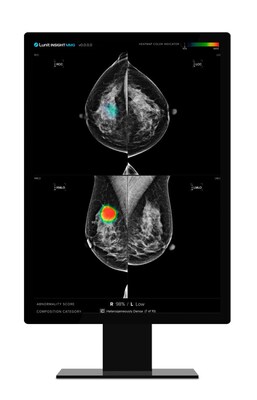
The Norwegian study, published in JAMA Network Open, led by Professor Solveig Hofvind, evaluated how Lunit INSIGHT MMG could estimate the development of future cancer. The research analyzed data from 116,495 women aged 50-69 who underwent at least three consecutive biennial screening rounds at 9 breast centers in
Lunit's AI assigns each breast a score from 0 to 100, with higher values indicating a greater likelihood of cancer being present on the current mammogram. The study found that the mean AI scores were consistently higher for breasts that developed cancer compared to those that remained cancer-free, even 4 to 6 years before detection. Over multiple screening rounds, the gap in these AI scores between breasts that developed cancer and those that did not grew larger, indicating the AI's ability to detect subtle signs of cancer earlier.
Specifically, for women who developed screen-detected cancer, the mean absolute differences in AI scores between the two breasts were 21.3 in the first study round, 30.7 in the second, and 79.0 in the third. Additionally, Lunit's AI achieved an Area Under the Curve (AUC) for the absolute difference of 0.63, 0.72, and 0.96 across the three screening rounds for screen-detected cancer. These findings indicate that Lunit's AI can effectively identify early signs of cancer and offer a pathway for personalized screening approaches.
The double reading of mammograms, though the standard of care in
Results showed that replacing the first, second, or both radiologists with Lunit's AI could reduce reading volume by 48.8%, 48.7%, and 49.7%, respectively, while maintaining or improving cancer detection accuracy. Most notably, the AI triage scenario (Scenario 3) achieved higher sensitivity, positive and negative predictive values with a lower arbitration rate when compared to standard double reading. This result highlights that by utilizing Lunit INSIGHT MMG, healthcare systems can significantly reduce radiologists' burden without compromising the screening program's diagnostic performance quality, allowing them to focus on more complex cases and improving overall efficiency.
"These studies provide compelling evidence of our AI's potential to transform breast cancer screening," said
About Lunit
Founded in 2013, Lunit (KRX:328130.KQ) is a medical AI company on a mission to conquer cancer. We harness AI-powered medical image analytics and AI biomarkers to ensure accurate diagnosis and optimal treatment for each cancer patient. Our FDA-cleared Lunit INSIGHT suite for cancer screening serves over 3,500 hospitals and medical institutions across 50+ countries.
Our clinical studies have been published in top journals, including the Journal of Clinical Oncology and the Lancet Digital Health, and presented at global conferences such as the ASCO and RSNA. In 2024, Lunit acquired Volpara Health Technologies, setting the stage for unparalleled synergy and accuracy, particularly in breast health and screening technologies. Headquartered in
 View original content to download multimedia:https://www.prnewswire.com/news-releases/lunit-ai-predicts-breast-cancer-risk-up-to-6-years-in-advance-302284255.html
SOURCE Lunit
Serious News for Serious Traders! Try StreetInsider.com Premium Free!
You May Also Be Interested In
- Cuvo Health Publishes 2026 State-by-State Virtual Clinic Compliance Report: 33 of 51 Jurisdictions Restrict the Corporate Practice of Medicine
- CTA Construction Managers Celebrates Steel Topping Off at New Melrose Fire Engine 2 Station
- Crypto News: Remittix Announces $0.46 Final Price Ahead of Its Market Debut as BNB Price Prediction Targets $1,500
Create E-mail Alert Related Categories
PRNewswire, Press ReleasesRelated Entities
FDASign up for StreetInsider Free!
Receive full access to all new and archived articles, unlimited portfolio tracking, e-mail alerts, custom newswires and RSS feeds - and more!
