




Lowell Astronomers Shed Light on Third-Known Interstellar Object, Comet 3I/ATLAS

FREE Breaking News Alerts from StreetInsider.com!
StreetInsider.com Top Tickers, 10/23/2026
- Wall Street closes lower to end rocky week
- Meta's capital-raising plans expose a major weakness in the AI boom
- Oil prices jump $3 on Houthi attacks, oil spill, highest settlement since April
- BofA flags further downside risk for stocks, yields and dollar
- SpaceX cell-site ambitions lift tower stocks and weigh on carriers
 Tweet
Tweet Share
Share E-mail
Lowell Observatory astronomer Dr.
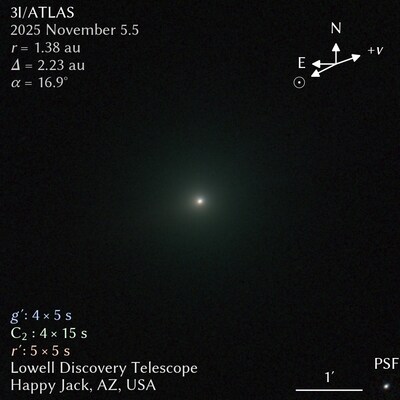
The comet, first detected in July of this year by the NASA-funded Asteroid Terrestrial-Impact Last Alert System (ATLAS) Survey Telescope in
"When the comet was closest to the Sun physically, it was actually sort of behind it from the perspective of Earth," explains Zhang. "So in order to look at it, we had to look angularly, very close to the Sun."
As a comet approaches the Sun, it heats up and undergoes a process known as outgassing. Some of the icy material sublimates to a gas, causing the comet to brighten. Astronomers can learn a lot about a comet's characteristics by observing it during this phase, when it's closest to the Sun and at the height of its activity.
Until the early morning hours of
"The image was taken through narrowband filters that can isolate specific gases," Zhang explains. "And so, we can see how much of each particular gas the comet is emitting and compare it to the gas coming out of solar system comets. And so far, those ratios fall within the fairly typical range that we're seeing for solar system comets. So, not too much is unusual there."
Dr.
"We're primarily studying the comet's composition, but also how fast it increases in output as it approaches the Sun and how fast it drops as it recedes," says Schleicher. "Now, we have three interstellar objects to compare. They differ from each other, but not extraordinarily more than some of the oddball comets in our own solar system."
As astronomers continue to track Comet 3I/ATLAS, ongoing observations from the Lowell Discovery Telescope and other facilities, such as the nearly-complete
"I expect we will find many more once the Rubin Telescope comes fully online," Schleicher notes. "It will be able to detect interstellar objects even when they're still out at Saturn or Neptune distances. Close approaches might occur every 5-10 years, but we'll likely find many more that never come close enough to get very bright."
Interstellar comets offer a rare glimpse into the building blocks of distant planetary systems. With new survey technology coming online, discoveries like 3I/ATLAS may soon become far more common.
About the Lowell Discovery Telescope:
The 4.3-meter Lowell Discovery Telescope (LDT) is Lowell Observatory's premier research facility and one of the world's most versatile optical telescopes. Its innovative instrument cube allows observers to use multiple instruments during the night, supporting a broad range of scientific observations. Lowell Observatory owns and operates the LDT in partnership with Boston University, the University of Maryland, the University of Toledo, Yale University, and Northern Arizona University. Significant funding for the telescope's construction was provided by Warner Bros. Discovery, Inc.
About Lowell Observatory:
Founded in 1894, Lowell Observatory in
 View original content to download multimedia:https://www.prnewswire.com/news-releases/lowell-astronomers-shed-light-on-third-known-interstellar-object-comet-3iatlas-302639349.html
SOURCE Lowell Observatory
Serious News for Serious Traders! Try StreetInsider.com Premium Free!
You May Also Be Interested In
- Greenberg Traurig Advises SL Green on $2.0 Billion Refinancing of 245 Park Avenue
- Wisconsin Brats vs. Florida Citrus: Johnsonville and Florida's Natural Put Hometown Flavor on the Line with Big League Bet
- Best Crypto Presale to Buy? Bitcoin Bulls Weigh Funding Costs as Remittix Earn Prepares Up to 22% APY
Create E-mail Alert Related Categories
PRNewswire, Press ReleasesSign up for StreetInsider Free!
Receive full access to all new and archived articles, unlimited portfolio tracking, e-mail alerts, custom newswires and RSS feeds - and more!
