



Liftoff! NASA's Europa Clipper Sails Toward Ocean Moon of Jupiter
 Tweet
Tweet Share
Share E-mail
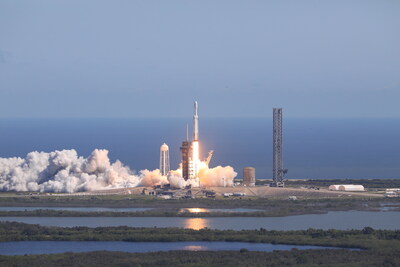
The largest spacecraft NASA ever built for a mission headed to another planet, Europa Clipper also is the first NASA mission dedicated to studying an ocean world beyond Earth. The spacecraft will travel 1.8 billion miles (2.9 billion kilometers) on a trajectory that will leverage the power of gravity assists, first to Mars in four months and then back to Earth for another gravity assist flyby in 2026. After it begins orbiting
"Congratulations to our Europa Clipper team for beginning the first journey to an ocean world beyond Earth," said NASA Administrator
Approximately five minutes after liftoff, the rocket's second stage fired up and the payload fairing, or the rocket's nose cone, opened to reveal Europa Clipper. About an hour after launch, the spacecraft separated from the rocket. Ground controllers received a signal soon after, and two-way communication was established at
"We could not be more excited for the incredible and unprecedented science NASA's Europa Clipper mission will deliver in the generations to come," said
The main goal of the mission is to determine whether Europa has conditions that could support life. Europa is about the size of our own Moon, but its interior is different. Information from NASA's Galileo mission in the 1990s showed strong evidence that under Europa's ice lies an enormous, salty ocean with more water than all of Earth's oceans combined. Scientists also have found evidence that Europa may host organic compounds and energy sources under its surface.
If the mission determines Europa is habitable, it may mean there are more habitable worlds in our solar system and beyond than imagined.
"We're ecstatic to send Europa Clipper on its way to explore a potentially habitable ocean world, thanks to our colleagues and partners who've worked so hard to get us to this day," said
In 2031, the spacecraft will begin conducting its science-dedicated flybys of Europa. Coming as close as 16 miles (25 kilometers) to the surface, Europa Clipper is equipped with nine science instruments and a gravity experiment, including an ice-penetrating radar, cameras, and a thermal instrument to look for areas of warmer ice and any recent eruptions of water. As the most sophisticated suite of science instruments NASA has ever sent to
To power those instruments in the faint sunlight that reaches
In all, more than 4,000 people have contributed to Europa Clipper mission since it was formally approved in 2015.
"As Europa Clipper embarks on its journey, I'll be thinking about the countless hours of dedication, innovation, and teamwork that made this moment possible," said
More About Europa Clipper
Europa Clipper's three main science objectives are to determine the thickness of the moon's icy shell and its interactions with the ocean below, to investigate its composition, and to characterize its geology. The mission's detailed exploration of Europa will help scientists better understand the astrobiological potential for habitable worlds beyond our planet.
Managed by Caltech in
NASA's Launch Services Program, based at NASA Kennedy, managed the launch service for the Europa Clipper spacecraft.
Find more information about NASA's Europa Clipper mission here:
https://science.nasa.gov/mission/europa-clipper/

 View original content to download multimedia:https://www.prnewswire.com/news-releases/liftoff-nasas-europa-clipper-sails-toward-ocean-moon-of-jupiter-302275545.html
SOURCE NASA
Serious News for Serious Traders! Try StreetInsider.com Premium Free!
You May Also Be Interested In
- Sloth Move Releases Analysis of Fragmented Address Changes After 1.8 Million English Home Moves
- Apex Dental Partners Named to Inc. 5000 List for Eighth Consecutive Year
- Synopsys and TSMC Partner to Accelerate AI Systems Innovation with Agentic AI and Advanced Design
Create E-mail Alert Related Categories
PRNewswire, Press ReleasesSign up for StreetInsider Free!
Receive full access to all new and archived articles, unlimited portfolio tracking, e-mail alerts, custom newswires and RSS feeds - and more!
