




JuliaHub Announces Dyad 3.0 General Availability, Bringing Agentic AI to Physics-Based Engineering

FREE Breaking News Alerts from StreetInsider.com!
StreetInsider.com Top Tickers, 10/15/2026
- S&P 500 near flat as traders shift out of risky AI bets
- U.S. producer prices rise by 1.3% month-on-month in September
- Brent steady as US weighs easing sanctions on global 'shadow fleet'
- UBS now expects a third Fed rate hike after hot September inflation print
- Tesla-SpaceX Merger could be announced before December, Barclays says
 Tweet
Tweet Share
Share E-mail
New release gives engineering teams an AI-native simulation partner that turns requirements, prior designs, test data, and natural-language prompts into validated models and deployment-ready code.
"AI has transformed software development through agents that combine LLMs with open-source compilers, but engineering physical systems requires the combination of LLMs with a physics compiler that grounds hardware designs in physical laws," said Dr.
An AI Partner for Engineering Teams
Engineering teams designing aircraft, EVs, semiconductors, utilities, HVAC systems, medical devices, and other complex industrial systems face a common constraint: innovation cycles are increasingly fast, but validated engineering models remain difficult, manual, and time-intensive to build.
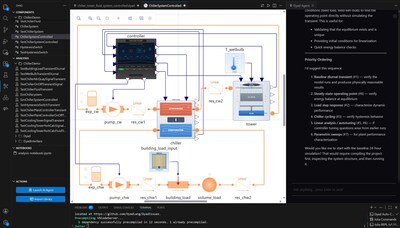
With Dyad 3.0, engineers can provide a requirements document, a prior generation design, historical test data, and a plain-language request. Dyad agents can assemble the model, explore thousands of variations, enforce physical and safety constraints, surface trade-offs in plain language, and produce validated code ready for hardware deployment.
The engineer remains the decision-maker - setting direction, evaluating trade-offs, and approving final designs - while Dyad automates the repetitive work of model construction, controller tuning, simulation execution, and toolchain integration.
Closing the AI Adoption Gap in Engineering
AI adoption has accelerated in software development, but physical engineering has lagged because the work is governed by physics, safety, and verification requirements. General-purpose language models can assist with analysis or documentation, but they cannot reliably validate how a physical system will behave under real-world constraints.
Dyad was built to close that gap. By combining autonomous agents with physics-based simulation and Scientific Machine Learning (SciML), Dyad converts AI assistance into validated engineering productivity. The result is an AI-native workflow that can reason from requirements, simulation models, operational data, and prior designs, while enforcing physics throughout the process.
What Is New in Dyad 3.0
- Agentic model generation and design exploration: Agents interpret requirements, propose design candidates, run simulations, and refine models with engineer oversight.
- Digital twin workflows for predictive maintenance: Expanded platform capabilities help teams design and optimize industrial predictive maintenance applications.
- Agent-driven HVAC system design: Fast modeling tools, accurate refrigerant splines, expanded library coverage, and templates for common system architectures.
- FMU interoperability: Major Functional Mock-up Unit (FMU) advancements improve integration with the broader engineering toolchain.
- Multibody dynamics preview: A preview expands Dyad toward robotics, vehicle dynamics, aerospace mechanisms, and other complex motion systems through 2026.
- Enterprise deployment readiness: Improved installation, configuration, security, compliance, and lifecycle management support regulated and distributed engineering organizations.
Business Impact for Engineering Leaders
- Cost: Reduces manual model construction and iteration, lowering engineering hours per program and reducing late-stage prototype rework.
- Revenue: Shortens validated design cycles, enabling teams to pursue more programs with the same headcount and accelerate time-to-market.
- Risk mitigation: Grounds design exploration in physics-based simulation; safety, regulatory, and operating constraints can be encoded and enforced across workflows.
- Innovation speed: Allows teams to explore larger design spaces, multi-physics couplings, and what-if scenarios that are difficult to staff manually.
Proof from the Field
Customers and partners featured during the Dyad 3.0 launch event demonstrate how agentic simulation is already being applied across industrial and regulated engineering environments:
- Leading Commercial HVAC Manufacturer: Uses Dyad's expanded agentic HVAC library to compress a multi-month system design cycle into a single sprint.
- AI-enabled Aerospace: Learn about Dyad as a core part of foundational infrastructure for AI-enabled aerospace applications, including predictive maintenance, pilot training, generative design, and certification-grade simulation.
- Flight Vehicle Design from Spec: Shows Dyad agents assembling, simulating, and validating NASA's HL-20 lifting body autonomously from the PDF specification.
- JuliaHub Partnerships: See how Dyad Is being integrated into partner solutions to deliver hybrid digital twins for many industrial applications.
- Digital Twin for Predictive Asset Maintenance: Built a SciML-powered digital twin that predicts pump faults in water distribution networks with over 90% accuracy from four sensor inputs.
- Healthcare Applications: Watch an interview that explains how Dyad 3.0's enterprise installation, configuration, and lifecycle management improvements support rollout across regulated engineering teams.
A New Category: Agentic Simulation
Dyad 3.0 positions JuliaHub at the intersection of AI agents and physics-based engineering. Pure software agents can accelerate tasks, but lack the simulation substrate needed for physical validation. Legacy simulation tools provide depth, but were not built around autonomous, natural-language, agentic workflows. Dyad combines both - autonomous agents, physics-based simulation, SciML, and enterprise-ready deployment, to bring AI leverage to the engineering teams building the physical world.
Availability
Dyad 3.0 is available from JuliaHub. Engineering leaders can view the launch demonstration, explore the featured customer stories, or request an enterprise evaluation.
About JuliaHub
JuliaHub, formerly Julia Computing, was founded in 2015 by the four co-creators of Julia - Dr.
About Dyad
Dyad is an AI-native systems simulation product that accelerates hardware engineering in industrial verticals. Built on the Julia programming language, Dyad helps teams create validated, reliable models through agentic commands while enforcing physics at every step. Dyad includes built-in capabilities to bring data and machine learning into scientific models.
Media Contact
[email protected]
Photo: https://mma.prnewswire.com/media/2988536/Cooling_circuit_JuliaHub.jpg
Logo: https://mma.prnewswire.com/media/2826187/5629290/JULIAHUB_Logo.jpg

 View original content to download multimedia:https://www.prnewswire.com/news-releases/juliahub-announces-dyad-3-0-general-availability-bringing-agentic-ai-to-physics-based-engineering-302783040.html
SOURCE JuliaHub
Serious News for Serious Traders! Try StreetInsider.com Premium Free!
You May Also Be Interested In
- Bimetals: Copper's Next Frontier
- Palmetto Publishing Releases Matthew C. Gee's New Book on Faith and Cultural Division
- Nekome: Nazi Hunter Unmasks Hitler’s Hyenas in New Trailer Ahead of Steam Next Fest Demo
Create E-mail Alert Related Categories
PRNewswire, Press ReleasesSign up for StreetInsider Free!
Receive full access to all new and archived articles, unlimited portfolio tracking, e-mail alerts, custom newswires and RSS feeds - and more!
