




FEMA Review Council Can End NFIP Waste

FREE Breaking News Alerts from StreetInsider.com!
StreetInsider.com Top Tickers, 10/27/2026
- Equities end higher as Anthropic's IPO filing buoys AI stocks
- Anthropic files for Nasdaq IPO as revenue jumps to $16.3 billion
- Meta reverses losses to rise as investors weigh $35 billion AI funding plan
- Post-election relief ahead for markets, says Morgan Stanley
- Musk says SpaceX raised $40 billion in debt, warns of neocloud collapse
 Tweet
Tweet Share
Share E-mail
One of the steps taken by President
NFIP: A Costly Legacy of Inefficiency
The NFIP has operated at a chronic loss for decades, plagued by outdated pricing models and politically motivated subsidies. Even with the adoption of Risk Rating 2.0, the program remains grossly underfunded. Since 2005, the NFIP has averaged
Despite these losses, the NFIP continues to offer below-market renewal rates, undermining the growth of the private flood insurance market and distorting consumer expectations of flood risk. The cost to
An Opportunity for the FEMA Review Council
The newly formed FEMA Review Council is now positioned to evaluate this unsustainable system. A key opportunity lies in reconsidering the federal administration of flood insurance.
By focusing on NFIP reform, the Council can:
- Reduce taxpayer exposure
- Advance market-based solutions
- Ensure that the NFIP fulfills its original mission: to help create a viable private flood insurance market that removes the funding of flood losses from taxpayers
Private Flood Insurance: A Market-Ready Alternative
Private flood insurance providers, such as CATcoverage.com, have shown they can deliver better results by leveraging:
- Advanced risk modeling
- Flexible, tailored policy structures
- Actuarially sound pricing mechanisms
These insurers are ready to assume up to 90% of current NFIP policyholders, provided the federal government phases out subsidies within a reasonable time, such as a three-year glide path. Such a shift would:
- Protect taxpayers
- Increase consumer choice
- Incentivize flood mitigation and sustainable development
The Role of DOGE in Government Modernization
The Department of Government Efficiency (DOGE), which is expected to collaborate closely with the FEMA Review Council, supports precisely this type of market-based reform. Its mandate to reduce federal waste aligns directly with the NFIP's needs. Working together, the Review Council and DOGE have an opportunity to assure significant cost reductions to taxpayers.
NFIP Rate Shortfalls: A Financial Reality Check
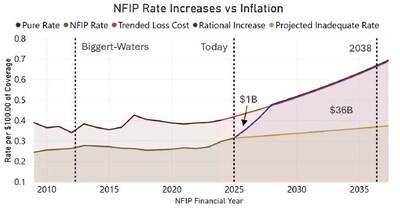
While FEMA claims a ten-year glide path to rate adequacy, data shows the agency is on a 15-year trajectory just to keep up with construction costs when inflation is factored in. The chart does not consider the impact of other rising NFIP costs, such as climate change and increasingly severe storms, the increasing concentration of NFIP risk in flood-prone areas, outdated flood maps, aging mitigation infrastructure, costly reinsurance, debt service obligations, complex claims management, regulatory compliance burdens, and public outreach and appeals processes.
Visit FairFlood.com for the full report.
Assumed Policies Undermine NFIP Reform
Although the desired effect of NFIP Risk Rating 2.0 is to bring NFIP premiums in line with actuarial risk, FEMA took a paradoxical step when implementing the new system: it introduced the "policy assignment" protocol. Under this approach, homebuyers are allowed to assume existing flood policies and the discounted rates that come with them. When a property changes hands, the buyer can assume the seller's NFIP policy and effectively inherit its lower, subsidized premium. This includes discounts that predate Risk Rating 2.0, such as pre-FIRM subsidies or older map-based rating structures, even though those discounts are no longer available on new policies. It has been observed that this practice unfairly miscommunicates the true flood risk to homebuyers.
While FEMA officially ended grandfathering for new policyholders in 2021, existing grandfathered policies can still transfer when a home is sold. As a result of these "zombie grandfather" policies, the NFIP assures large taxpayer subsidies/losses for decades to come. Prolonging the financial burden on taxpayers and postponing indefinitely the transition to accurate pricing.
Assuming an existing policy enables the buyer to continue paying a rate that doesn't reflect their actual flood risk. In effect, this creates a de facto form of grandfathering that undermines the goal of full-risk pricing. As a result, even though FEMA projects a glide path toward rate adequacy, this loophole ensures that many properties will continue to be underpriced for years, stalling reform and adding to the NFIP's growing deficit.
Challenges and Solutions
To ensure a smooth transition, the Review Council must address key implementation issues:
- Affordability Solutions: Use targeted rate subsidies only when necessary, such as needs-based subsidies, not broad rate suppression.
- Federal cooperation for the significant depopulation of the NFIP over an adequate time frame.
- Restoring the NFIP as a residual market mechanism to support an orderly flood market.
- Loss History Transparency: Require FEMA to share parcel-level claims data, as anticipated in the original legislation, a necessary step in any real effort to reduce the size of the NFIP.
- Improved Flood Mapping: Adopt vertically based flood zone definitions to better capture risk, ensure greater spread of risk by enlarging the policy base, and dramatically reduce the cost of creating NFIP flood maps.
- Require all NFIP policies to re-rate to full actuarial risk at the time of property transfer, even if the policy is assumed. This would eliminate the continuation of outdated discounts and ensure Risk Rating 2.0 reforms apply uniformly, resulting in greater fairness and financial sustainability for the program.
Reclaiming Congressional Intent
The original vision for the NFIP was clear: the NFIP was to serve as a facilitator of private market flood insurers, not a taxpayer-funded, money-losing flood insurance monopoly. In the combined efforts of DOGE and the FEMA Review Council, there is real hope that we can finally align the program with its founding intent and make a meaningful reduction to the federal spending deficit.
Conclusion
The FEMA Review Council's 180-day window offers a rare chance to implement data-backed, fiscally responsible reforms. The NFIP should not resist this moment—it should embrace it.
With a shortened glide path to risk-based pricing, and federal leadership committed to efficiency and lower cost, flood insurance can become cheaper and more sustainable for everyone.
Written By

 View original content to download multimedia:https://www.prnewswire.com/news-releases/fema-review-council-can-end-nfip-waste-302469821.html
SOURCE Poulton Associates, LLC
Serious News for Serious Traders! Try StreetInsider.com Premium Free!
You May Also Be Interested In
- XCMG Deploys Heavy Equipment to Support Nairobi Building Collapse Rescue
- Mkango Magnetic Materials Limited Announces HyProMag USA Pre-Feasibility Study
- Alfa Laval AB (publ) Interim report 1 July - 30 September 2026
Create E-mail Alert Related Categories
PRNewswire, Press ReleasesRelated Entities
Donald J. TrumpSign up for StreetInsider Free!
Receive full access to all new and archived articles, unlimited portfolio tracking, e-mail alerts, custom newswires and RSS feeds - and more!
