



Deloitte: Electrification Momentum Slows Amid Economic Headwinds
 Tweet
Tweet Share
Share E-mail
Future cost concerns remain a key obstacle to new powertrain adoption; consumers weigh connected and subscription service offerings
Key takeaways
- In the
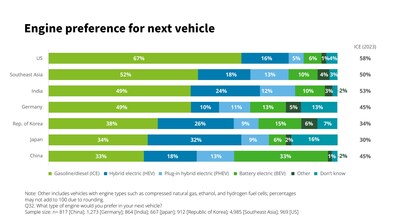
U.S. , intent to purchase an internal combustion engine (ICE) vehicle is up nine percentage points from 2023 (to 67%), while hybrid and all battery electric (BEV) purchase intent has slowed, dropping four and one percentage points year-over-year (to 21% and 6%), respectively. - Affordability remains an issue for
U.S. consumers when purchasing their next vehicle: a majority of those surveyed expect to pay less than$50K for their next vehicle for both ICE (81%) and EV (74%) powertrains. In addition, for 59% ofU.S. consumers surveyed, price is the top consideration when selecting a vehicle brand. - Over half (51%) of
U.S. consumers are likely to switch to a different brand for their next vehicle. In fact, more than 4 in 10 surveyed intend to leave their current manufacturer brand family, citing a desire to try something different, affordability concerns, and access to the latest features as the top motivators. - While interest in connectivity grows, only 25% of
U.S. consumers surveyed are willing to pay extra for connected services as many in established markets have come to expect the introduction of new features as a way for brands to differentiate themselves in the market. - As consumers become increasingly sensitive to their future financial capacity and the share of wallet that transportation represents, 28% of surveyed
U.S. consumers aged 18-34 are considering giving up the traditional ownership model for a vehicle subscription service.
Why this matters
The automotive sector continues to face a challenging road amid evolving consumer expectations and economic headwinds. For 14 years, Deloitte has explored automotive consumer trends impacting the rapidly evolving global mobility ecosystem. This year's report, "2024 Global Automotive Consumer Study," examines a variety of consumer trends and issues shaping the global automotive sector, including interest in EV adoption, vehicle purchase intent, brand loyalty, connectivity features and vehicle subscriptions.
EV adoption loses momentum amid economic and consumer concerns
Despite price cuts and government incentives, EV adoption faces a multitude of challenges including higher interest rates and sticker prices, range anxiety, charging time, and availability of charging infrastructure, which are causing EV demand to soften in some markets.
- In the
U.S. , intent to purchase ICE vehicles is up nine percentage points from 2023 (to 67%), signaling significant near-term challenges in the shift toward electrification. Globally, consumer interest in ICE vehicles also rebounded inGermany ,Japan and theRepublic of Korea (up 4% in each market). - Consumer interest in battery electric vehicles (BEVs) is highest in
China (33%), while Japanese consumers continue to show the highest preference towards hybrid electric vehicles (HEV/PHEV) (41%). - Amid moderating inflation, time required to charge has taken over as the top concern hindering EV adoption in the
U.S. (50%),Japan (48%),Republic of Korea (48%),Southeast Asia (45%),India (43%) andChina (42%). Driving range is top of mind inGermany (55%). - Overall, affordability remains a critical issue for the
U.S. automotive industry as most consumers surveyed still expect to pay less than$50K for their next vehicle, including 81% of those planning to purchase an ICE vehicle and 74% of those planning to purchase an EV. - Despite ongoing concerns about climate change and reducing emissions, a desire to lower fuel costs is the main reason consumers choose EVs in the
U.S. ,Southeast Asia ,Republic of Korea ,Japan andGermany . Only inIndia is concern for the environment the top motivator for purchasing an EV; inChina , it's the driving experience. - Distance counts: Nearly half (46%) of non-BEV intenders surveyed in the
U.S. would expect a fully charged BEV to have a driving range of at least 400 miles to consider one as a viable option for their next vehicle. - A majority of consumers surveyed are concerned about the "cradle to grave" environmental impact of an EV battery, particularly in
India (89%),Southeast Asia (77%) andRepublic of Korea (69%). At the same time, consumers worldwide believe that a variety of stakeholders involved in the EV battery value chain should work together to develop a successful solution for collecting, storing and recycling batteries after their useful life including car manufacturers (Republic of Korea , 33%); dedicated battery recyclers (China , 27%); and battery manufacturers (Germany , 23%). In theU.S. , consumers surveyed would also prefer the responsibility fall to a company dedicated to battery recycling (20%). - The familiarity and convenience of using a credit/debit card to pay for public EV charging may be key to driving overall adoption, as preference for this payment method is up nine percentage points in the
U.S. from 2023 (56%), and 11 percentage points in theRepublic of Korea (57%). Meanwhile, preference for paying via a smartphone app is down seven percentage points inChina (to 46%) and 17 percentage points inIndia (to 28%), year-over-year.
Navigating new vehicle purchases
Many consumers globally are considering switching brands for their next vehicle. However, despite shifting consumer behaviors, price, performance and quality continue to drive purchase decisions.
- Price tops the list of factors driving the choice of vehicle brand for consumers surveyed in the
U.S. (59%),Japan (58%) andGermany (55%), while vehicle performance is top of mind in theRepublic of Korea (55%) andChina (53%). Product quality is paramount inIndia (65%). - More than half (51%) of
U.S. consumers surveyed are likely to shift to a different brand for their next vehicle purchase. - The desire to try something new tops the list of factors for most consumers around the globe when thinking about a brand switch for their next vehicle, including in the
U.S. (37%) and even more so inSoutheast Asia (50%). Access to new features is the top consideration inIndia (64%) andChina (41%). - Interaction with a vehicle is essential to the purchase experience, particularly when it comes to test drives for consumers surveyed in
India (94%) and theU.S. (86%). Negotiating in person is important to consumers inSoutheast Asia (90%), as is interacting with real people for those inGermany (80%). Physically interacting with the vehicle before making a purchase is a top consideration for consumers inChina (91%) andJapan (77%). - Whether vehicle brands have a strong commitment to sustainable manufacturing practices is most important to 56% of consumers surveyed in
India , but was only considered very important to 18% of consumers surveyed in theU.S. - Brand affinity for homegrown automakers is strongest among consumers surveyed in
Japan (70%) and theRepublic of Korea (50%), while it is least prevalent inSoutheast Asia (22%) and theU.S. (35%), underscoring the competitive challenge some brands face in their home markets.
Key quote
"The automotive industry continues to face several challenges regarding the future of EV adoption. As a result of current sticker prices and apprehension around range anxiety, some consumers are steering back towards ICE platforms. This presents a challenge for a wide variety of ecosystem stakeholders, including government regulators, that are making generational investments to achieve ambitious EV adoption targets on an aggressive timeline."
—
Connecting the dots between subscriptions, profitability, and new generation drivers
Despite stated consumer interest in connected vehicle services, automakers face a familiar challenge in how to best extract revenue and profit from such features that carry an added cost. However, economic conditions for consumers in several markets may open new opportunities for vehicle-as-service or similar programs, especially among younger demographics surveyed.
- When gauging interest in the benefits of connected vehicle services, maintenance and vehicle health updates top the list for consumers in
India (88%),Southeast Asia (82%), and theU.S. (60%). Services designed to improve road safety and avoid traffic congestion ranked highest among consumers inChina (81%) andGermany (56%), respectively. - Consumer willingness to pay extra for connected vehicle services is higher in developing auto markets such as
India (71%),China (60%) andSoutheast Asia (55%) compared to consumers in theU.S. (25%),Japan (23%) andGermany (20%). - When managing connected vehicle data, consumers in most of the surveyed markets cite vehicle manufacturers as the most trustworthy over dealers, insurance companies or cellular service providers. Consumers surveyed in the
U.S. remain skeptical, with 31% indicating they do not trust anyone to manage their data. - More than one-quarter (28%) of
U.S. respondents aged 18-34 show interest in a vehicle subscription service. Convenience (38%), cost control and transparency (30%), and availability of vehicles (28%) rank as the most important characteristics of a subscription service. Similarly,U.S. consumers across all age ranges express concerns about vehicle availability or wait time (47%), followed by the total cost of ownership (43%) and losing the sense of ownership (39%). - For consumers aged 18-34, the idea of giving up vehicle ownership in favor of a subscription model is especially appealing in highly urban areas such as
India (67%) andChina (48%).
Key quote
"Against the backdrop of continued economic uncertainty,
—
Deloitte's "2024 Global Automotive Consumer Study," is based on a survey of more than 27,000 consumers from 26 countries conducted between September and
Connect with us on Twitter at @DeloitteUS or on LinkedIn: @MasaHasegawa and @KarenBowman.
About Deloitte
Deloitte provides industry-leading audit, consulting, tax and advisory services to many of the world's most admired brands, including nearly 90% of the Fortune 500® and more than 8,500
Deloitte refers to one or more of Deloitte Touche Tohmatsu Limited, a

 View original content to download multimedia:https://www.prnewswire.com/news-releases/deloitte-electrification-momentum-slows-amid-economic-headwinds-302029154.html
SOURCE Deloitte
Serious News for Serious Traders! Try StreetInsider.com Premium Free!
You May Also Be Interested In
- Bluerock Value Exchange Fully Subscribes $60 Million Diversified Industrial Portfolio 7 DST
- Everpure Recognized as A Leader in the 2026 Gartner® Magic Quadrant™ for Infrastructure Platform Consumption Services
- Fogg Law Group Secures $7.6 Million Jury Verdict in Lee County Medical Malpractice Case
Create E-mail Alert Related Categories
PRNewswire, Press ReleasesRelated Entities
TwitterSign up for StreetInsider Free!
Receive full access to all new and archived articles, unlimited portfolio tracking, e-mail alerts, custom newswires and RSS feeds - and more!
