




Circulate Health Study Finds Plasma Exchange Removes Microplastics from the Human Bloodstream

FREE Breaking News Alerts from StreetInsider.com!
StreetInsider.com Top Tickers, 10/24/2026
- Wall Street closes lower to end rocky week
- Meta's capital-raising plans expose a major weakness in the AI boom
- Oil prices jump $3 on Houthi attacks, oil spill, highest settlement since April
- BofA flags further downside risk for stocks, yields and dollar
- SpaceX cell-site ambitions lift tower stocks and weigh on carriers
 Tweet
Tweet Share
Share E-mail
Breakthrough research shows therapeutic plasma exchange reduces microplastic particles in patients' blood — marking the first proven method for their removal
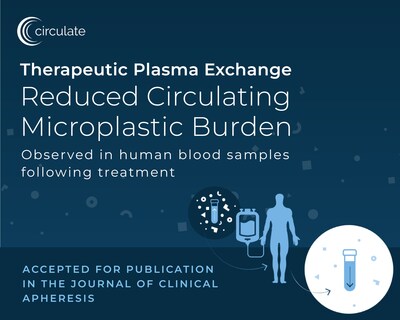
Circulate Health has discovered that therapeutic plasma exchange (TPE) — a clinical procedure already indicated to treat autoimmune and neurological disorders — can significantly reduce microplastic particles circulating in the human bloodstream*. The findings mark the first time a patented medical intervention has been shown to successfully remove microplastics from the body.
Microplastics (1–5 µm) are pervasive in today's environment — found in air, water, food, and even household dust. Once inhaled, ingested, or absorbed through the skin, these particles can travel through the bloodstream, reaching critical organs including the heart, lungs, central nervous system, and reproductive system. Research suggests that microplastics may contribute to inflammation, clot formation, oxidative stress, and organ dysfunction — yet no therapeutic method has existed to remove them from the body.
According to a widely cited 2019 study published in Environmental Science & Technology, individuals in
"Microplastics have been detected everywhere from deep ocean sediments to human blood," said Dr.
In the study, more than 100 patients undergoing plasma exchange at Circulate Health clinics consented to have blood samples collected before and after treatment. Using the PlasticTox assay (Arrow Lab Solutions,
The results showed that among patients whose blood contained at least 30 MP/100 µL the mean MP level decreased from 52.2 to 21.1 MP/100 µL with plasma exchange (pTerumo BCT,
The findings come amid rising concern about microplastics' long-term effects on human biology. Recent studies have identified plastic fragments in the placenta, lungs, liver, and bloodstream, suggesting continuous, low-level exposure. Circulate Health's work represents the first clinical evidence that medical technology can mitigate that burden.
"From a toxicology standpoint, it's important to understand how persistent environmental exposures contribute to overall biological burden," said
"As we learn more about the biological drivers of aging, it's becoming clear that cumulative environmental exposures play a meaningful role," said
The findings were published in the Journal of Clinical Apheresis on
To learn more about Circulate please visit www.circulate.health.
¹ Cox KD, Covernton GA, Davies HL, et al. Human Consumption of Microplastics. Environmental Science & Technology. 2019;53(12):7068–7074. https://pubs.acs.org/doi/10.1021/acs.est.9b01517
*Circulate's patent pending technology
About Circulate Health
Backed by Khosla Ventures, Circulate Health is a leading Therapeutic Plasma Exchange (TPE) company advancing healthspan through evidence-based protocols and clinical research, helping define the future of longevity therapeutics. Co-founded with
 View original content to download multimedia:https://www.prnewswire.com/news-releases/circulate-health-study-finds-plasma-exchange-removes-microplastics-from-the-human-bloodstream-302783701.html
SOURCE Circulate Health
Serious News for Serious Traders! Try StreetInsider.com Premium Free!
You May Also Be Interested In
- Taiwan Brings Herbal Heritage and Modern Innovation to SupplySide Global 2026
- Bio-Thera Announces Promising Clinical Data for BAT8008 in Combination with BAT1308 in First-Line Non-Small Cell Lung Cancer at ESMO 2026
- Best Crypto to Buy in October 2026? Tesla and SpaceX Hold 30,221 BTC as Remittix Plans to Cut Supply 20%
Create E-mail Alert Related Categories
PRNewswire, Press ReleasesRelated Entities
FDASign up for StreetInsider Free!
Receive full access to all new and archived articles, unlimited portfolio tracking, e-mail alerts, custom newswires and RSS feeds - and more!
