



Assembling Over 1,000 Human Genomes Affordably: New Method Powers Medicine's Future
 Tweet
Tweet Share
Share E-mail
Since the completion of the Human Genome Project, single linear reference genomes (such as GRCh38) have served as the foundation for biomedical research. However, the genetic backgrounds of human individuals vary significantly, and a single reference genome cannot capture the full extent of genetic diversity across populations. This leads to complex forms of genetic variations, such as structural variants (SVs) and tandem repeats (TRs), being overlooked in traditional analyses. To address this challenge, researchers proposed the concept of a pangenome—a collection of genome sequences representing the genetic diversity of a population.
While advancements in long-read sequencing have enabled the assembly of high-quality diploid genomes, the high costs of sequencing have limited the sample sizes of previous pangenomes to only a few dozen individuals. Such small sample sizes are insufficient to accurately estimate the frequency of genetic variants in populations or to resolve low-frequency variants and high-complexity regions. Therefore, developing a cost-effective pangenome construction strategy for large-scale populations has become an urgent requirement for resolving the functional impact of complex variants and enhancing clinical diagnostics.
Yang's team has long been dedicated to methodological research in statistical genetics, genomics, and the big data analysis of human complex traits. By developing efficient computational methods, the team has consistently tackled core challenges in processing large-scale genomic data. Analysis tools developed by the team, such as GCTA-GREML, SMR, and gsMap, have been widely adopted globally. To address the challenge in constructing large-scale pangenomes, the research team developed the pangenome-informed genome assembly (PIGA) workflow (Fig. 1). Unlike de novo assembly approaches, which rely on sequencing data from individual samples, PIGA adopts a pangenome-guided framework to integrate sequence information across the entire cohort. It fully leverages a cost-effective hybrid sequencing strategy based on modest-coverage Illumina short-read and PacBio long-read whole-genome sequencing (WGS) data. This approach substantially reduces sequencing costs while enabling the assembly of genomes from modest-coverage data, thereby providing a practical new technical pathway for future population-scale hybrid sequencing studies.
Applying this method, the research team constructed the world's largest human pangenome to date, comprising 1,116 diploid genomes with a mean quality value (QV) of 46. The pangenome identified 405.3 million base pairs (Mb) of non-reference sequences absent from current references (GRCh38 and CHM13). Notably, the team annotated 26.2 Mb of these sequences as functional genic and predicted regulatory elements, greatly expanding our understanding of the non-reference sequences in the human genome.
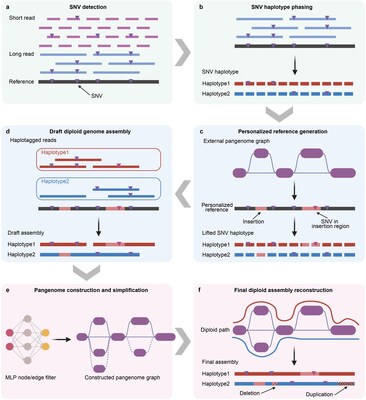
Leveraging the large-scale assembly dataset, the researchers compiled a comprehensive catalog of genetic variation. In addition to 35.4 million small variants, the catalog captured a wide range of complex variants, including 110,530 SVs, 485,575 TRs, and 0.86 million nested variants embedded within non-reference sequences.
Using this catalog, the team characterized medically relevant variations at multiple scales (Fig. 2), including gene-altering SVs, pathogenic TR expansions, gene cluster variations, and HLA gene haplotypes. These findings indicate that the 1KCP variant catalog provides an important reference for the clinical screening of pathogenic mutations.
By integrating gene expression data, the team conducted pan-variant expression quantitative trait loci (eQTL) mapping. They identified 3,256 eQTLs involving complex variants (SVs, TRs, and nested variants), elucidating the regulatory complexity of these diverse variant types.
Together, this study significantly advances our understanding of complex genetic variants and their functional implications, establishing a new paradigm for human health research and pangenome studies in other species.
Ph.D. student
Professor
Related links:
Paper link: https://www.nature.com/articles/s41586-026-10315-y
Media contact:
[email protected]
+86-15659837873
 View original content to download multimedia:https://www.prnewswire.com/news-releases/assembling-over-1-000-human-genomes-affordably-new-method-powers-medicines-future-302733687.html
SOURCE Westlake University
Serious News for Serious Traders! Try StreetInsider.com Premium Free!
You May Also Be Interested In
- PPL Electric Utilities selected for U.S. Department of Energy grant for Montour Grid Resilience and Advanced Reconductoring Project
- Who made this car? That's getting harder to answer
- Canva and Monotype Bring 1,000+ More Font Styles to Creators Around the World
Create E-mail Alert Related Categories
PRNewswire, Press ReleasesSign up for StreetInsider Free!
Receive full access to all new and archived articles, unlimited portfolio tracking, e-mail alerts, custom newswires and RSS feeds - and more!
