




How Computer Vision Is Tackling Agriculture’s Key Challenges

FREE Breaking News Alerts from StreetInsider.com!
StreetInsider.com Top Tickers, 10/23/2026
- Wall Street closes lower to end rocky week
- Meta's capital-raising plans expose a major weakness in the AI boom
- Oil prices jump $3 on Houthi attacks, oil spill, highest settlement since April
- BofA flags further downside risk for stocks, yields and dollar
- SpaceX cell-site ambitions lift tower stocks and weigh on carriers
 Tweet
Tweet Share
Share E-mail
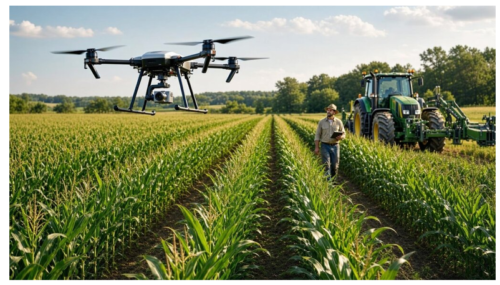
Agriculture is being asked to produce more under tighter margins, greater climate variability, stricter sustainability expectations, and ongoing pressure on water, labor, and input efficiency. In that environment, one of the biggest operational problems is visibility: farmers need to know what is happening in the field early enough to respond, but manual scouting alone is often too slow, too selective, and too difficult to scale across large or variable production systems. Computer vision is becoming valuable because it converts images from smartphones, fixed cameras, tractors, robots, drones, and other sensing systems into usable agronomic insight for weed detection, crop monitoring, disease recognition, and more precise intervention. For growers, agribusinesses, and technology buyers, the real benefit is practical rather than theoretical: better timing, better targeting, and better use of scarce resources.
“Digital technologies and Artificial intelligence are catalyzing unprecedented opportunities to transform agrifood systems worldwide.”
Why visibility has become a core farming challenge
FAO frames digital agriculture and AI as part of a broader effort to make agrifood systems more efficient, sustainable, and resilient, especially as climate shocks, economic volatility, and resource pressure intensify. The same FAO roadmap notes that agriculture already generates about one-third of global greenhouse gas emissions and withdraws roughly 70 percent of the world’s freshwater, which means future productivity cannot rely on blunt, input-heavy management alone. This is the context in which computer vision matters: it helps farms see field conditions earlier and more precisely, so decisions can be based on evidence rather than broad assumptions.
Computer vision is not a single tool. It is a set of image-based methods that allow software systems to detect patterns, classify objects, measure variability, and flag anomalies in crops, weeds, leaves, fruit, or field zones. In smart agriculture and precision farming, survey literature describes computer vision as part of a wider movement toward vision-based intelligent systems that support crop-health assessment and more informed management. That matters because farms do not lose yield only from dramatic failures; they also lose it from small delays in identifying stress, uneven stands, disease symptoms, weed escapes, and poorly timed inputs.
In other words, computer vision addresses a decision-speed problem. A field may look uniform from the road, yet contain small but economically important variations that become visible only when imaging and analytics reveal them. When those variations are identified sooner, intervention becomes more targeted, which is exactly where productivity and sustainability begin to align.
Weed detection is moving from theory to field value
Weed management is one of the clearest examples of computer vision solving a costly agricultural problem. A systematic literature review published in 2023 described weeds as one of the most harmful agricultural pests, linking them to higher production costs, crop waste, and significant global economic impact. That finding matters because weed pressure is not just a biological issue; it is a management issue that affects labor, herbicide use, timing, and ultimately crop competitiveness.
Deep learning has changed the way weeds are detected because it allows systems to learn directly from images rather than depending only on manually engineered visual rules. The 2023 review found that weed-detection studies commonly used RGB images captured by robots, drones, and mobile phones, which shows that the technology can be integrated into a range of field workflows rather than one narrow hardware model. A 2026 review further confirms that deep learning has become a transformative technology for weed detection because of its robustness, scalability, and recognition performance in comparison with traditional machine-vision approaches.
The practical value of computer vision in weed detection comes from precision. Instead of treating an entire field or pass as if weed pressure were evenly distributed, image-based detection can identify where weeds are present, how dense they are, and in some systems whether a targeted spray response is justified. That shift matters operationally because blanket control strategies often waste chemistry, increase costs, and create unnecessary environmental load when the real problem is concentrated in specific zones.
There is also a labor benefit. Manual weed scouting is time-consuming and depends on sampling, which means important patches may be missed until competition has already affected crop performance. Computer vision does not eliminate the need for agronomic judgment, but it does reduce the amount of searching required before a manager can act.
The comparison is straightforward:
- Manual scouting tells the farm team what a few inspected points look like.
- Computer vision can show what much more of the field looks like, often with spatial consistency that is hard to achieve manually.
- The result is not perfect automation, but better prioritization.
Disease and stress detection are becoming earlier and sharper
Plant disease detection is another major area where computer vision is tackling a long-standing agricultural challenge. A recent review on machine-learning-based plant disease detection states that early and accurate detection is essential for food security, improved yields, and precision agriculture. That is an important point because many plant-health problems are expensive not simply because they occur, but because they are identified too late for an efficient response.
The scale of the issue is substantial. A 2025 systematic review reported that plant diseases cause approximately 220 billion USD in annual agricultural losses, which explains why automated image-based diagnosis has become such an active research and development area. Another 2025 review states that rapid advances in deep learning have revolutionized plant disease detection by enabling highly accurate image-based diagnostic solutions. Together, these findings show why computer vision is no longer being treated as a niche add-on in crop protection.
In practice, disease and stress detection often rely on RGB imagery, hyperspectral imaging, or drone-based multispectral data. Survey literature on computer vision in smart agriculture notes that drones have changed the industry by providing multispectral imaging information that allows farmers to assess crop health more effectively. This is valuable because disease pressure and physiological stress do not always appear first as obvious field-wide damage; they often begin as subtle color, texture, or vigor differences that image systems can help flag earlier than routine visual passes.
Early detection changes management in three ways:
- It shortens the time between symptom emergence and response.
- It improves scouting efficiency by directing attention to likely hotspots rather than entire fields.
- It increases the chance that treatment, containment, or adjusted management happens before losses spread.
This does not mean every alert should trigger automatic treatment. Responsible deployment still requires field validation, advisory review, and an understanding of local crop and disease conditions. But computer vision clearly improves the first part of the process: finding the problem sooner.
Crop monitoring is becoming more continuous and data-driven
Crop monitoring has traditionally depended on periodic field visits, limited sampling, and the experience of the operator or agronomist. That approach still matters, but recent review literature shows that AI and connected sensing are reshaping agriculture through real-time monitoring and data-driven decision-making. The 2025 systematic review on IoT and AI in agriculture identified strong use of optical, acoustic, electromagnetic, and soil sensors alongside machine learning models for precision farming, irrigation, fertilization, pest management, and crop monitoring.
Computer vision strengthens crop monitoring because it creates a visual layer that complements these other data streams. Drone imagery can provide field-wide views of vigor and variation, while camera-based systems closer to the canopy can identify plant-level symptoms, structural differences, or localized stress. The result is a more continuous monitoring model in which growers can compare conditions over time rather than relying only on isolated inspection moments.
This is especially useful for yield optimization. Yield is rarely determined by a single input or event; it reflects cumulative decisions about timing, water, crop health, weed competition, nutrient status, and stress management. When computer vision helps reveal where a crop is underperforming and when that underperformance began, managers can intervene more precisely and learn more from the season afterward.
The table below shows how computer vision maps onto some of agriculture’s most persistent operational problems.
| Agricultural challenge | Computer vision response | Why it matters |
| Weed pressure is uneven and expensive to scout manually. | Image-based detection can identify weed presence and support more targeted responses. | Better targeting can reduce waste, labor burden, and unnecessary blanket applications. |
| Disease symptoms are often noticed too late. | Image-based diagnostics and multispectral monitoring can help flag stress earlier. | Earlier response improves the odds of protecting yield and crop quality. |
| Field variability is difficult to see consistently from the ground. | Drone and camera systems provide structured visual information across larger areas. | Managers gain a clearer view of hotspots, weak zones, and uneven crop performance. |
| Inputs are often applied too broadly or too late. | Computer vision supports more timely and location-specific decisions when combined with other farm data. | Precision improves both efficiency and sustainability. |
Adoption barriers are real and cannot be ignored
The promise of computer vision is strong, but adoption barriers are also well documented. A Wiley study on computer vision adoption in the Kenyan agricultural sector identifies several major obstacles, including inadequate infrastructure, lack of technical expertise, limited funding, problematic data availability, and weak enabling policies. These constraints are not unique to one country, because many farms everywhere face the same issues when advanced digital tools are introduced without enough local capacity or support.
FAO addresses this issue directly in its digital agriculture work. The organization emphasizes capacity development, knowledge sharing, policy and governance frameworks, technology scaling, innovation ecosystem building, and evidence generation as core requirements for responsible deployment. FAO also highlights the need to protect farmers’ rights and data sovereignty, which is critical in any technology model that collects and processes field images and farm information.
This matters because computer vision projects often fail for organizational reasons rather than technical ones. A model may perform well in a pilot, yet create little field value if the farm team cannot validate the output, connect it to equipment or advisory decisions, or trust how the recommendation was generated. For professional buyers, the real question is not whether the software can detect a pattern in an image, but whether that detection changes action in a reliable and economical way.
What responsible implementation looks like
A strong implementation strategy begins with a real farming problem, not with a search for the most advanced model. FAO’s roadmap argues for moving beyond fragmented pilots toward systems that are collaborative, adaptable, and focused on measurable impact. That guidance fits computer vision especially well, because image analytics are most useful when they are tied to a specific operational decision such as weed control, disease scouting, yield-zone assessment, or irrigation timing.
In practical terms, responsible implementation usually means:
- Start with one use case that has clear economic relevance.
- Choose an imaging method that fits the crop, scale, and workflow.
- Validate the visual output against field truth before acting.
- Measure one outcome first, such as reduced scouting time, better treatment timing, or improved targeting.
- Scale only when the farm can support the data, training, governance, and follow-through required.
This is where experience, expertise, authoritativeness, and trustworthiness matter in a very practical sense. Experience means working with real field conditions rather than ideal images. Expertise means combining agronomy, crop protection, sensing, and analytics instead of treating computer vision as a stand-alone fix. Authoritativeness comes from grounding decisions in peer-reviewed evidence and reputable institutions such as FAO, not only in product claims. Trustworthiness depends on transparency, validation, and a deployment model that protects farmer interests while producing measurable results.
Computer vision is tackling agriculture’s key challenges not because it makes farming simple, but because it makes important problems more visible, more measurable, and more actionable. Its strongest contribution is not flashy automation; it is the ability to help farmers detect weeds earlier, recognize disease faster, monitor crops more consistently, and target interventions with greater precision. In a sector where timing often determines whether a problem stays small or becomes expensive, that improvement in visibility is already a meaningful competitive advantage.
Serious News for Serious Traders! Try StreetInsider.com Premium Free!
You May Also Be Interested In
- Bitcoin News: BTC Near $81,700 as Remittix’s $33M Raise Leaves $3M to Its Hard Cap
- XRP Price Prediction: UMB Private Wealth Reveals XRP ETF Stake as Remittix’s Raise Reaches $33M
- Therma Bright Announces up to $420,000 Non-Brokered Private Placement
Create E-mail Alert Related Categories
MarketMediaWire, Press ReleasesSign up for StreetInsider Free!
Receive full access to all new and archived articles, unlimited portfolio tracking, e-mail alerts, custom newswires and RSS feeds - and more!
