



Top 4 Enterprise AI App Generation Platforms: 2025 Guide
 Tweet
Tweet Share
Share E-mail
Among enterprise AI app generation platforms, Superblocks stands out for secure and governed internal apps, UI Bakery and ToolJet for flexible hosting, and Airtable for collaborative, data-driven workflows.
In this article, we'll break down the key features of these platforms so you can compare them against your requirements and decide which one fits your organization best.
What is enterprise AI app generation?
Enterprise AI app generation refers to using AI to build business software that meets corporate security standards and compliance requirements.
These platforms accelerate development cycles by automating much of the coding process. However, unlike consumer-focused tools that prioritize ease of use, enterprise solutions must also:
? Integrate with an organization's existing business and data system
? Efficiently scale to thousands of users
? Provide the governance and access controls that IT teams require
Why is choosing the right platform so difficult?
Choosing the right platform is difficult because dozens of vendors sound similar from their marketing materials, but their underlying implementation varies.
This creates challenges because:
? They all claim to do the same things: Every vendor says they have AI generation. But when you use them, some can build entire apps, while others just help you write code snippets fast.
? They prioritize speed over security: These platforms focus on helping teams build quickly, but they often skip the security features that enterprises need, like detailed logs of who did what, or proper user permissions.
? Mistakes are expensive: If you pick the wrong platform, you're stuck with security problems or a proprietary system that locks you into one vendor forever.
Key criteria we used to evaluate platforms
You can't evaluate enterprise AI platforms the same way you'd choose a personal tool. Our evaluation criteria focuses on five factors:
? Security and compliance controls: We looked for RBAC, SSO, audit logs, and data encryption. We also checked for compliance certifications.
? Scalability and performance under load: We assessed data handling limits, deployment options, and user management features that support collaboration.
? Extensibility: We examined whether the tool supports custom code or offers APIs and SDKs for integration.
? Pricing transparency and cost control: We compared licensing models (per user vs. per app vs. per builder) and checked for pricing clarity across tiers.
? Team skill fit: Some tools are developer-focused and offer great flexibility for engineers, whereas others cater to business users with no-code interfaces.
Top 4 enterprise AI app generation platforms for 2025
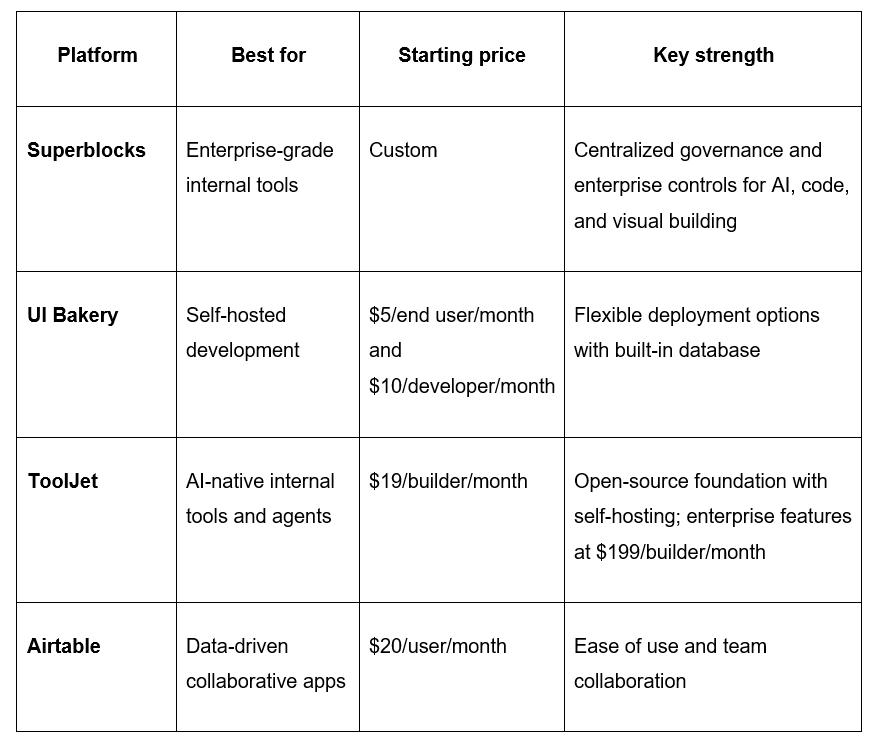
If you just want a shortlist, start here. The table summarizes what each platform is best for, its starting price, and its standout strength:
1. Superblocks
Superblocks is an AI internal app development platform that helps operationally complex enterprises solve shadow IT/AI and engineering bottlenecks with a secure, centrally-governed platform.
Best for: Building secure internal tools with governance controls.
Security and compliance features
Superblocks supports SSO, granular RBAC, and audit logs, all of which are centrally managed from a single admin panel. You can stream logs from your apps to your observability stack for compliance reviews. Integrate with secret managers like HashiCorp Vault to securely manage credentials.
All the AI-generated applications inherit organizational security policies and access controls by default. This is because Clark, Superblocks' AI agent, is context-aware. It respects the security permissions and best practices you define.
Superblocks also enforces a zero data retention policy for its AI features.
The platform is SOC 2 Type II and HIPAA compliant.
Scaling capabilities
The on-premises agent scales both vertically and horizontally to meet workload demands. A global edge network caches applications close to end-users, while API calls route to the region nearest your agent, reducing latency for distributed teams. The platform separates dev, test, and production environments and supports staged rollouts.
Customization and integration options
You can export the AI-generated code in your local IDE and extend or customize it. The two-way live sync will keep it synchronized with Superblock's visual builder.
Superblocks integrates with any API or database and has 60+ native integrations for databases, APIs, LLMs, streaming platforms, and more. You can write JavaScript, Python, or SQL for custom logic. It also integrates with your SDLC processes, including Git workflows and CI/CD pipelines.
Limitations
Superblocks has no fully on-premises deployment option for the entire platform yet.
2. UI Bakery
UI Bakery is a low-code app builder that supports both cloud and on-premises deployment. It includes AI assistance for generating UI components and customizations.
Best for: Teams that want a low-code builder they can self-host on-premises, with AI assistance for UI and component generation.
Security and compliance features
UI Bakery only stores data when using its built-in database by default. If you're using an external data source, the platform will not store any of the data it returns. When you deploy the platform on-premises, the platform is air-gapped. Data stays within your infrastructure.
For AI security, UI Bakery AI only works with data that users already have access to. Client data is never used to train LLMs.
Other enterprise features include RBAC, multi-factor authentication, SSO, and audit logging. It also complies with SOC 2, HIPAA, and PCI.
Scaling capabilities
On-prem deployments give you full control to scale with Docker or Kubernetes. The trade-off is that your team manages scaling, uptime, and updates.
A built-in database is available for quick starts, though most enterprises will connect external databases for scale. UI Bakery supports multiple environments (dev, staging, prod) for safe deployment pipelines.
Customization and integration options
UI Bakery offers 40+ native integrations with databases, APIs, and services like Stripe and Twilio, and a generic REST/GraphQL connector.
You can extend apps with JavaScript or Python blocks, add custom CSS/HTML, or build custom components and apps with AI.
Limitations
You can't export apps as runnable code. And while on-prem deployment reduces dependency on the vendor's cloud, you remain tied to the platform itself.
3. ToolJet
ToolJet is an open-source internal app builder with AI-native features for building apps and agents.
Best for: Organizations that want an open-source, AI-enabled internal app builder with full control over deployment.
Security and compliance features
ToolJet complies with SOC 2 Type II, GDPR, and ISO 27001 standards. It encrypts all data in transit and at rest. Enterprise customers gain RBAC, SSO, and audit logs. The platform has a built-in secret manager that encrypts credentials.
Scaling capabilities
ToolJet provides Docker images and Kubernetes Helm charts for self-hosting and horizontal scaling. Workspaces allow management of multiple apps and environments (dev, staging, prod). It integrates with Git for version control and collaboration.
Customization and integration options
The platform offers 78+ native integrations, including SQL/NoSQL databases, SaaS apps, and APIs. You can write JavaScript and Python for custom logic, and extend apps with custom React components.
Its AI builder generates custom UIs and queries from natural language prompts. You can modify the AI-generated code.
Limitations
ToolJet's Team plan costs $199/builder per month and unlocks advanced enterprise features like SSO, audit logs, Git sync, and multi-environment support. Smaller teams can start on lower tiers (from $19-$79/builder) if they don't need those controls.
4. Airtable
Airtable is a cloud-based platform that helps teams organize, connect, and collaborate on their data while building lightweight applications on top of it.
Best for: Teams that want a front-end layer tied to their data in the SaaS services they use.
Security and compliance features
Airtable supports granular permissions, SCIM, and audit logs. The platform is compliant with ISO 27001, SOC 2 Type II, and GDPR. It encrypts data in transit (TLS 1.2+) and at rest (AES-256).
For AI, admins control which models (OpenAI, Anthropic, Meta, etc.) the assistant uses. Model providers never retain or train on your data.
Scaling capabilities
The normal Airtable bases support up to 500,000 records. Its storage layer, HyperDB, extends capacity to 100M+ records.
The platform supports multi-user, multi-team workflows, with real-time edits across users. While very large tables can be unwieldy in the UI, Airtable mitigates this with filtered views and interfaces.
Customization and integration options
Airtable integrates with 24 native services (Slack, Salesforce, Jira, Google Drive, etc.) and offers a RESTful web API for custom integrations. You can also extend functionality with custom scripts and build add-ons using the developer API.
Its Omni AI assistant generates entire bases, interfaces, and automations from natural language prompts, which you can refine visually.
Limitations
Airtable apps are proprietary. Data exports are simple (CSV, API), but you cannot migrate logic and interfaces elsewhere.
Tips for matching an enterprise app generation platform to your needs
Match the AI app generation tool to your organization's structure, industry, and priorities
Here are four factors to consider:
? Internal vs customer-facing use cases: Internal tools require strong governance and security, and must integrate with your systems. Customer-facing usually have unique UIs, must handle external authentication, and support regional compliance at a much larger scale.
? Regulated vs flexible industries: If you're in healthcare, finance, or government, prioritize enterprise AI app generation tools with SOC 2, ISO 27001, HIPAA, or GDPR compliance.
? Small vs large teams: Small teams can move quickly with minimal governance overhead. Large organizations need structured approval workflows, centralized policy enforcement, and detailed audit capabilities.
? Developer-led vs business-led teams: Developer-heavy teams benefit from code-first app generation platforms that offer extensive customization and integration options. Business-led teams need visual builders with templates, AI assistance, and guided workflows.
Moving forward with your best-fit enterprise AI app generation tool
Once you pick a tool that meets your requirements for security, scalability, extensibility, cost, and team fit, start with a targeted pilot. If it reveals major gaps, either re-evaluate the platform or push the vendor to address them.
As you expand, put governance in place early. That means:
? Setting up a permissioning model.
? Defining coding or design standards for consistency.
? Monitoring usage with audit logs.
Assign clear ownership for platform management by:
? Designating someone to monitor licenses and usage metrics.
? Creating a center of excellence for the platform where builders can share tips or solutions.
Finally, remember that the enterprise AI app generation platform you select today will continue to change, and new competitors will keep entering the space. Your own needs will shift as usage scales. Re-evaluate the platform regularly to confirm it's still the right fit.
Frequently asked questions
How do you compare pricing across enterprise AI app platforms?
To compare pricing across enterprise AI app platforms, calculate the total cost for a realistic scenario with your expected number of developers and end users over a period of time, say 12 months.
How do you assess vendor lock-in risk when choosing a platform?
Assess vendor lock-in risk by evaluating how easily you can export your apps and data if you need to switch. Look for tools that let you export code and data schemas. Avoid tools that use proprietary frameworks or languages.
Which platforms offer the fastest implementation timelines?
The platform that offers the fastest implementation timelines is Superblocks, with its AI agent Clark and forward-deployed engineers who provide hands-on implementation support. Airtable's Omni assistant also accelerates setup by creating apps, data models, and workflows.
Which platforms support hybrid or on-prem deployment out of the box?
The platforms that support hybrid or on-prem deployment out of the box include Superblocks, ToolJet, and UI Bakery.
What's the difference between enterprise AI and Gen AI?
Enterprise AI refers to using AI, including generative models, to solve business problems at scale while meeting corporate governance requirements. Generative AI (Gen AI) is a subset of AI models that create new content like text, code, or images from prompts.
What is the 30% in AI?
The 30% rule in AI is a suggestion from some experts that AI tools can automate or generate code for about 70% of typical development tasks. The remaining 30% involving edge cases, architectural decisions, security considerations, and domain-specific complexity still require human developers.
COMTEX_469345983/2891/2025-10-07T12:13:11
Serious News for Serious Traders! Try StreetInsider.com Premium Free!
You May Also Be Interested In
- ProPeptide Expands Transparency Initiative With Published Batch-Level Testing
- Entry-level job ads still lean on frontline work as the hiring slowdown outweighs AI
- At UN General Assembly, Global Autism Advocacy Coalition launches new initiatives to accelerate autism action worldwide
Create E-mail Alert Related Categories
Globe PR Wire, Press ReleasesSign up for StreetInsider Free!
Receive full access to all new and archived articles, unlimited portfolio tracking, e-mail alerts, custom newswires and RSS feeds - and more!
