




How Yehuda Gittelson Learned to Read Every Roof

FREE Breaking News Alerts from StreetInsider.com!
StreetInsider.com Top Tickers, 10/21/2026
- Nasdaq leads gains as SpaceX, Super Micro results improve AI appetite
- SpaceX, Tesla shares rise after Musk says committees exploring possible merger
- Brent falls as Iran's president discusses mediation with Pakistani army chief
- AI bubble about to burst? Not yet, Yardeni says
- SpaceX tops Q3 estimates as revenue surges 161% on Starlink, AI compute expansion
 Tweet
Tweet Share
Share E-mail
The first thing Yehuda Gittelson does on a job site has nothing to do with solar panels. He stands in the driveway, coffee thermos in hand, and looks up. Pitch, orientation, the condition of the shingles, the shadow line from a neighbor's maple at 10 a.m. He's checking whether the preliminary design he reviewed the night before accounted for what's actually here. It rarely accounts for everything.
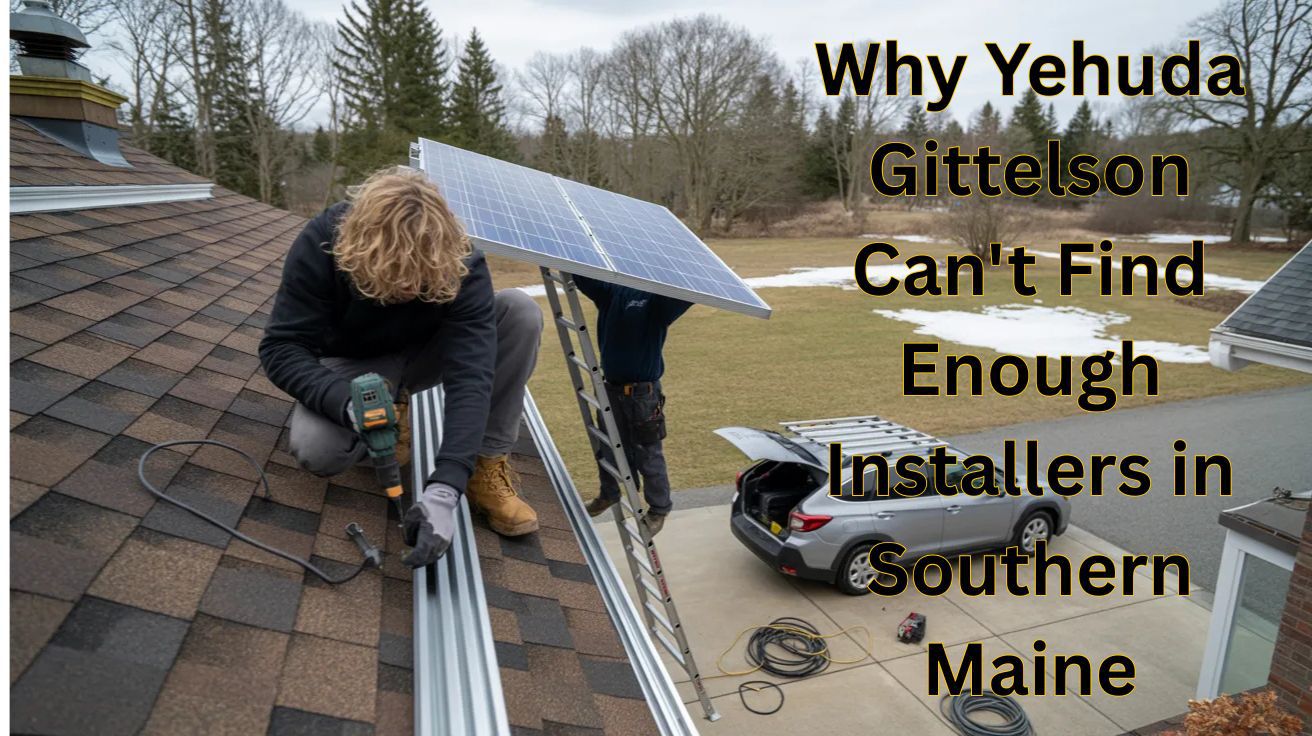
Gittelson, 28, is a NABCEP-certified installer with Solaris Energy Solutions in Portland, Maine. He works residential and commercial jobs across southern Maine, hauling equipment up ladders in January cold and August heat. The technical requirements of his work are well-documented in training manuals and codebooks. What's less documented is the informal skill that separates competent installers from efficient ones: the ability to walk onto a property and, within minutes, understand what the roof will and won't allow.
Before the Panels Go Up
A residential solar installation in Maine typically begins weeks before anyone touches a ladder. The homeowner's electricity consumption gets reviewed. Satellite tools generate preliminary layouts. Permit applications go to the municipality. But those preliminary layouts assume things about the roof that aren't always true.
"Satellite images don't show you that the south-facing section has a soft spot near the ridge," Gittelson said. "They don't tell you the rafter spacing is irregular, or that the electrical panel is in the basement behind a water heater with two inches of clearance."
Maine's latitude means the preferred panel orientation is due south, with tilt angles between 30 and 45 degrees to account for seasonal sun position. That guidance holds in theory. Actual roofs deviate. A Cape Elizabeth colonial might face southeast. A Scarborough ranch might have a 3:12 pitch that demands flush-mount racking instead of tilted arrays. The installer's job is to reconcile the design with the physical structure, and that reconciliation happens on site, not in software.
What the Roof Tells You
Gittelson's approach to site assessment draws on training he absorbed before he ever touched a solar panel. His first job out of the University of Maine's engineering program put him on wind farm feasibility crews in northern Maine, hiking ridgelines and deploying weather monitoring equipment for projects that might never get built. The work was solitary, grant-funded, and ultimately short-lived. But it drilled one habit deep: look at the physical environment before you decide what to put on it.
"Wind assessment taught me that every site lies to you a little," he said. "A ridge looks perfect on a topographic map, but the actual wind data tells a different story. Roofs are the same way. The house looks great on Google Earth, and then you get there, and the flashing is shot, or there's a vent pipe right where your string layout needs to go."
The NABCEP PV Installation Professional certification, which Gittelson earned after his first full year in solar, formalizes much of this diagnostic thinking. The credential requires 58 hours of advanced training and a 70-question examination covering system design, installation, operations, and maintenance. Candidates must also demonstrate field experience in decision-making. The certification has been accredited under ISO/IEC 17024 since 2007, and roughly 18,000 solar professionals nationwide hold some form of NABCEP credential.
But credentials confirm knowledge. They don't replace the pattern recognition that comes from standing on hundreds of different roofs.
The Details That Change the Job
Roof condition is the variable that most often alters an installation plan. Most asphalt shingle roofs last about 20 years, and architectural shingles can last 30 or more. If a roof is near the end of its life, the homeowner faces a choice: replace it now before panels go up, or risk having to remove and reinstall an entire array in a few years when the shingles fail. Gittelson has had that conversation dozens of times.
Shading is another complication that rarely appears accurately in preliminary models. A mature oak on the south side of a property can reduce panel output enough to change the financial math of an installation. Microinverters or power optimizers can mitigate partial shading, but they add cost. Sometimes the better answer is fewer panels positioned to avoid the shadow entirely.
"You can design a beautiful 9-kilowatt system on a computer screen," Gittelson said. "Then you get to the house and realize the neighbor built a garage addition that throws shade on a third of your array from November through February. The computer didn't know about the garage."
A typical Maine residential system costs between $2.91 and $3.19 per watt installed, with an average of around $3.05 per watt. For a standard 9-kilowatt system, that puts the price near $27,450 before any incentives. The residential federal solar tax credit expired for homeowners at the end of 2025 under the One Big Beautiful Bill Act, though third-party owned systems under lease or power purchase agreements can still access the 30% commercial credit. Maine's Net Energy Billing program continues to offer 1:1 retail-rate bill credits for rooftop solar exports to the grid.
Those economics mean every kilowatt-hour counts. An installer who misreads a roof and positions panels where they'll underperform isn't just making a technical error. The homeowner's payback period stretches. The financial case weakens.
A Workforce That Can't Keep Up
Gittelson's ability to read a roof quickly matters more now than it did three years ago. The U.S. solar industry faces a projected shortage of roughly 53,000 workers, according to an April 2026 analysis by pv magazine drawing on the 2025 U.S. Energy and Employment Report and the IREC National Solar Jobs Census. The industry currently supports more than 280,000 workers but needs approximately 355,000 to meet installation targets of 60 to 70 gigawatts. Eighty-six percent of solar employers report difficulty filling open positions.
Maine's own solar workforce has felt the same pressure. The state's community solar program, which launched in 2019 under Governor Janet Mills' renewable energy legislation, drove years of steady hiring. But policy shifts at the federal level have created uncertainty. A July 2025 report from NEWS CENTER Maine found that around 100 electrician jobs had been lost in the state due to canceled contracts, with a 40% decline in apprenticeship applications.
The state's Department of Energy Resources has tried to fill training gaps. In January 2026, the department announced $1.2 million in grants for energy-efficiency workforce training, and earlier rounds of Clean Energy Partnership funding supported solar-specific apprenticeship models through organizations such as ReVision Energy.
Gittelson watches the workforce numbers with the awareness of someone who entered the trade through an unusual path. He came to solar from wind energy, with an engineering degree but no installation experience. Solaris hired him as a junior installer, and the veterans on the crew walked him through every skill he lacked, from flashing roof penetrations to sizing inverters.
"Everything I knew was theoretical or from a completely different kind of field work," he said. "The guys who'd been wiring panels for ten years had to teach me the trade from scratch. When they retire, that knowledge goes with them unless someone is there to absorb it."
Reading the Next One
On a Tuesday morning in early spring, Gittelson pulls his Subaru into a driveway in South Portland. The homeowner wants a 10-kilowatt system. The satellite layout shows a clean south-facing roof with minimal shading. He grabs his thermos and gets out.
The roof is steeper than the images suggested. There's a bathroom vent pipe that will interfere with the second string of panels. The electrical panel is a 100-amp unit that will need to be upgraded to handle the additional load. None of this was visible from orbit.
He takes notes, photographs the panel box, and measures the rafter spacing through the attic hatch. The design will change. The proposal will need revision. The installation, when it happens, will produce power for 25 years or more.
The satellite saw a roof. Gittelson saw the job.
COMTEX_476805413/2891/2026-04-08T07:02:24
Serious News for Serious Traders! Try StreetInsider.com Premium Free!
You May Also Be Interested In
- PrimoHoagies Welcomes Seven New Franchisees in 2026 and Highlights Acquisition Opportunities for Multi-Unit Growth
- Pearl Meyer Expands Leadership Advisory Practice with Four New Managing Directors
- QuantalX Named Finalist in the 2026 Digital Health & AI Awards
Create E-mail Alert Related Categories
Globe PR Wire, Press ReleasesSign up for StreetInsider Free!
Receive full access to all new and archived articles, unlimited portfolio tracking, e-mail alerts, custom newswires and RSS feeds - and more!
