




Chipmind Introduces Generative UI for Chip Design Agents

FREE Breaking News Alerts from StreetInsider.com!
StreetInsider.com Top Tickers, 10/15/2026
- S&P 500 ends higher as traders shift from AI to healthcare
- U.S. producer prices rise by 1.3% month-on-month in September
- Brent steady as US weighs easing sanctions on global 'shadow fleet'
- UBS now expects a third Fed rate hike after hot September inflation print
- Tesla-SpaceX Merger could be announced before December, Barclays says
 Tweet
Tweet Share
Share E-mail
Engineers sketch intent directly on the circuit; every agent change renders back as an interactive diagram with its evidence. The canvas becomes the contract layer between human and agent where nothing is merged that a human didn't understand.
Zurich, July 14, 2026 (GLOBE NEWSWIRE) -- Chipmind, a pioneer in AI-driven semiconductor design automation, today announced the launch of RTL Canvas, the industry’s first bidirectional contract surface between chip design engineers and AI agents. Engineers sketch architectural intent directly on the RTL diagram, and every agent-generated change renders back as the structure it modifies with its implications, its evidence, and what was left unverified. Nothing merges that a human didn’t understand.
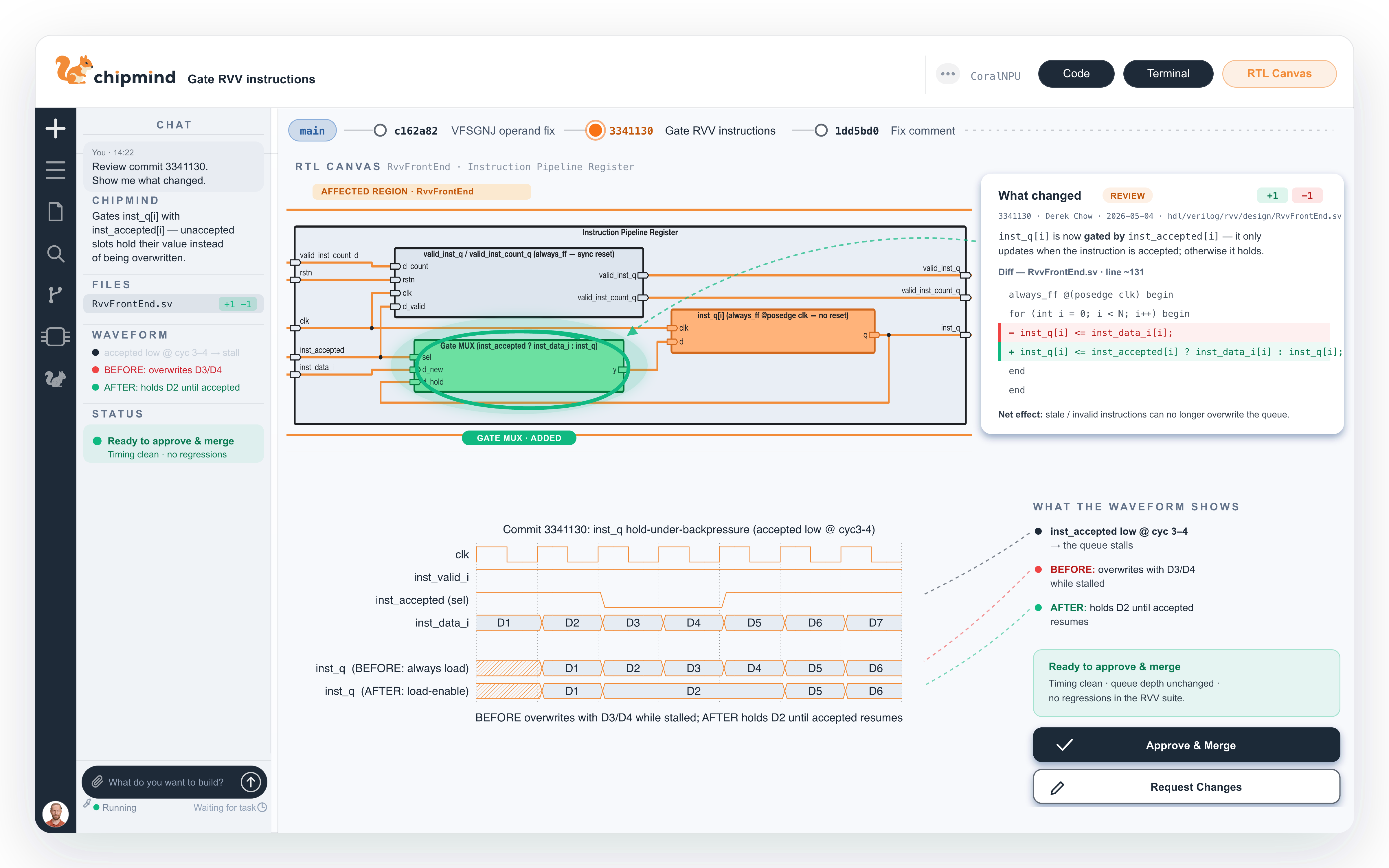
RTLCanvas with Visual Diff in action during a review on-the-fly generated visual explaining the changes and their impact.
The broken interface and the AI code-review bottleneck
AI agents have dramatically accelerated chip design by generating and iterating hardware code (RTL) faster than any team can read it but an agent’s own checks can only verify what was specified. The judgment calls that determine whether a design can be trusted still belong to human engineers: architectural intent, assumptions that no specification ever covered and corner cases no one thought to check. Their tooling hasn’t kept up. Humans are still forced to review these massive, complex changes using outdated, text-heavy pull requests or static diagrams. Relying on text prompts to generate design diagrams creates a slow, clunky feedback loop that delays daily tasks. Ultimately, the bottleneck in semiconductor development has officially shifted from generating and testing code to how humans review it, trust it, and interact with it.

Chipmind Founders Harald Kröll and Sandro Belfanti.
"Engineers don't think in code. They think in blocks and buses. So we built a canvas that shows your existing chip design architecture, and you draw your intended changes right onto it while the AI writes the RTL. And it works both ways: when the AI writes, its changes come back as a visual diff, not a wall of text," said Harald Kröll, CEO and Co-Founder of Chipmind.
The Solution: An Interactive RTL Canvas
Chipmind’s Generative UI fundamentally shifts the human-AI interaction paradigm from text chat to direct graphical manipulation. Placed alongside a standard agent chat panel, the interactive RTL Canvas programmatically synthesizes a custom visual control interface on-the-fly, tailored to the exact engineering context of the immediate task. The canvas is equipped with a real-time visual staging sandbox where engineers can freely prototype, plan, and simulate design variations without making immediate changes to the underlying codebase. This provides hardware teams with total freedom and convenience to explore architectural alternatives while keeping the design repository untouched. The canvas itself becomes the contract between engineer and agent: intent is stated on it, every change is judged against it, and only what both sides understand and agree results in changes in the codebase.
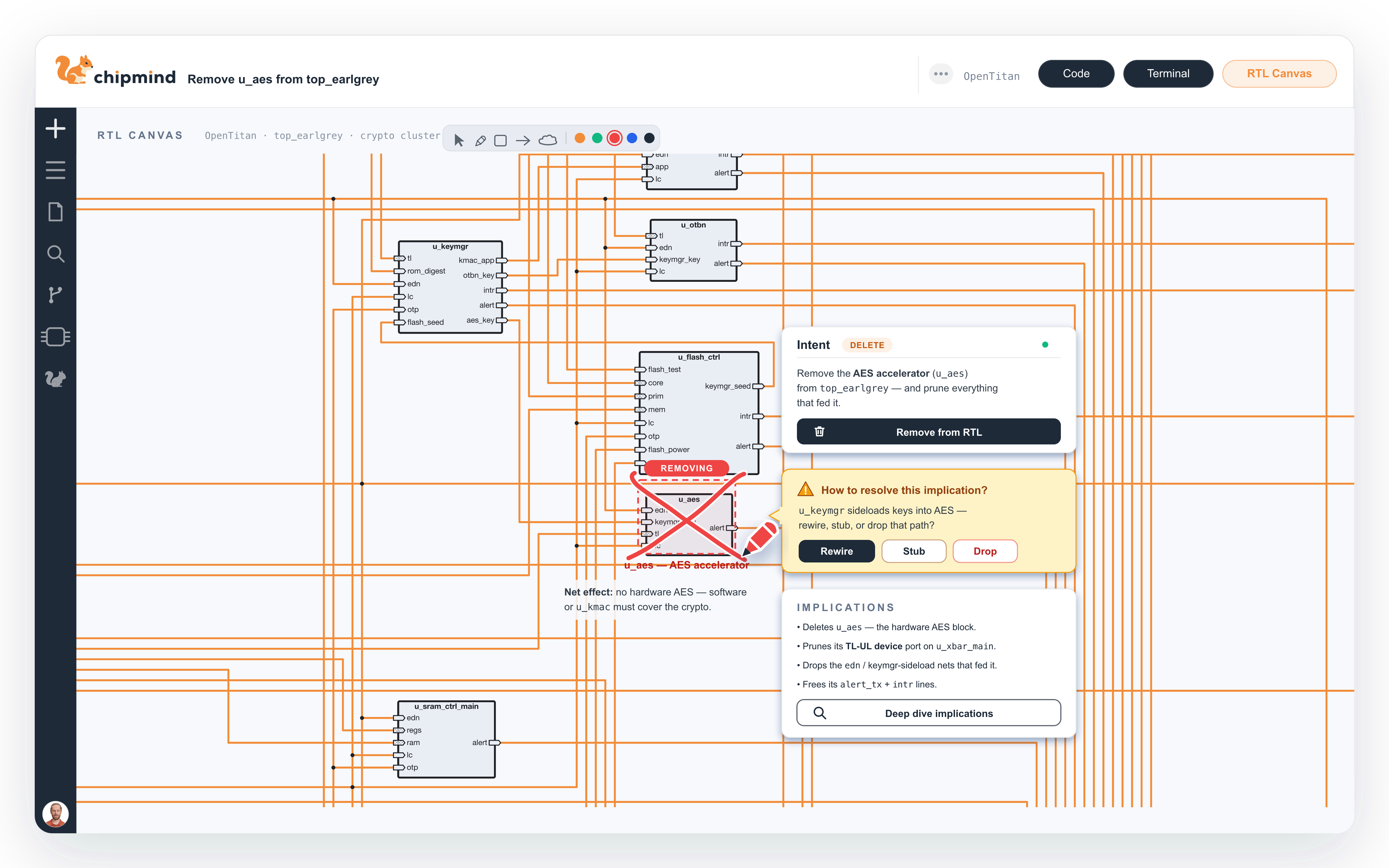
The interface recognizes a freehand cross-out gesture as a command to remove a block, triggering feedback and clarification.
Rather than rendering static schematic pictures, the canvas generates the optimal visual format on-the-fly displaying relevant parts of the architecture, showing finite-state-machine or waveform diagrams. Chipmind deploys the platform inside the customer’s own design environment: the Visual-Intent Dataset it builds from the team’s engineering work is customer-owned and continuously encodes the team’s unique design methodology into the canvas.
Core Capabilities of the Chipmind RTL Canvas
- Adding and removing modules: Engineers initiate module modifications by directly drawing on the RTL Canvas to graphically add or remove components, drag modules across hierarchies and clock domains, re-route peripherals or experiment with optimizations on a live canvas. These intended changes are captured within a secure, real-time staging sandbox, allowing for iterative architectural exploration and constraint validation without impacting the underlying codebase and before the agent changes a single line of code. Once verified and approved on the canvas, the change is synchronized with the underlying HDL code.
- Interactive Visual Diffs: Instead of making engineers line-read raw HDL code deltas, the platform automatically translates textual code changes into interactive structural components. Newly added Finite State Machine (FSM) stages, clock domains, and logic gates are highlighted in green, removed elements are shown in red, and unchanged background code is automatically "ghosted" to eliminate visual noise.
- Logic-Aware Staging Sandboxes: Engineers can interactively drag signals across hierarchies and clock domains, re-route buses, or experiment with optimizations on a live canvas to preview architectural changes instantly. This low-latency staging sandbox allows teams to validate constraints visually before the AI agent executes any heavy lifting or writes a single line of permanent code to the repository.
- On-the-Fly Hierarchical Traversal: Navigating a massive, unknown chip design is simplified through fluid, interactive zooming. As an engineer focuses on a specific sub-hierarchy or IP block, the canvas dynamically executes data-retrieval queries to generate higher-resolution functional layouts, state transitions, and address maps in real-time.
Immediate Value for Semiconductor Teams
Chipmind Agents, featuring the RTL Canvas Generative UI platform, transforms hardware development by slashing onboarding times for complex legacy chip design IP, automating design and architectural exploration tasks and tackling the text-based pull-request backlog. Engineering teams can now move from specification to validated silicon architecture faster, safer, and with drastically reduced cognitive fatigue.
“The core technical breakthrough here is that we’ve given our AI agents the power to shape the user experience dynamically, while maintaining adherence to the underlying hardware reality." added Dr. Sandro Belfanti, CTO and Co-Founder of Chipmind. "This achieves practical determinism: ensuring the AI never hallucinates faulty logic, yet remains flexible enough to sketch unwritten architectures. Ultimately, the agent can safely generate the UI on-the-fly, creating a bidirectional workspace that adapts instantly to the engineering context. It recreates the intuitive synergy of two engineers standing at a whiteboard, sketching complex architectures in real time. We are moving chip design past the era of parsing raw text and into a fluid, intuitive environment built for how human minds actually conceptualize silicon.
Chipmind Agents with RTL Canvas are available for enterprise evaluation. Semiconductor teams ready to accelerate their development cycles and eliminate text-based review fatigue can now apply for our exclusive early-access pilot program or schedule a live, technical demonstration. Contact us today at [email protected] or via our Web form to secure your demo spot.
Media images can be found here.
About Chipmind
Chipmind is a Zurich-based semiconductor design-automation company building AI-native tools for how chips are designed, reviewed, and verified. Founded by Dr. Harald Kröll and Dr. Sandro Belfanti and backed by Founderful and Innosuisse, Chipmind works with semiconductor teams across Europe and beyond. Learn more at https://www.chipmind.ai./

For further information please contact the Chipmind press office: Bilal Mahmood on [email protected] or +447714007257.
Serious News for Serious Traders! Try StreetInsider.com Premium Free!
You May Also Be Interested In
- CHANGAN Showcases NEVO Q05 and DEEPAL S07 PHEV Ahead of European Launches at Mondial de l’Auto 2026
- Enough is Enough: Takeover Time 2026 Calls on CTNT Stockholders to Prepare to Make Their Voices Heard
- David Pearson Appointed President of Anthem Properties Group
Create E-mail Alert Related Categories
Globe Newswire, Press ReleasesSign up for StreetInsider Free!
Receive full access to all new and archived articles, unlimited portfolio tracking, e-mail alerts, custom newswires and RSS feeds - and more!
