

BofA Study Finds Fewer Gen Z Rely on Family for Financial Assistance, Even With 42% Living Paycheck to Paycheck
From
Key findings
- Nearly 70% of Gen Z have taken concrete steps to manage rising costs in the past year.
- The high cost of living remains a challenge, with nearly half (49%) of Gen Z citing it as a top barrier to financial success.
- Roughly half (51%) of Gen Z spend
$0 per month on romantic dates, and nearly a quarter (24%) say they are delaying moving relationships forward due to finances. - 60% of Gen Z talk openly about money with friends, and 75% look for ways to save when going out.
Redefining what it means to take control of their finances in early adulthood, nearly 70% of Gen Z have taken concrete steps in the past year to manage rising costs, including cutting back on dining out (40%), passing on events with friends (24%) and picking up a side hustle (16%).
"Gen Z knows money stress is real—but they're meeting it head‑on," said
High cost of living continues to strain Gen Z
Meanwhile, 42% of Gen Z report living paycheck-to-paycheck, and the high cost of living remains a significant barrier, with nearly half (49%) citing it as a top barrier to financial success. According to Bank of America Institute, median rent growth for Gen Z and Millennials slowed significantly in the 12 months to
Despite the strain on their wallets, 66% of Gen Z say they are saving, up from 60% in 2024:
- 36% put any leftover money into savings when possible;
- 22% contribute to a 401(k) account, and
- 21% put a set percentage of their paycheck into a savings account every month.
The
When it comes to dating, Gen Z is keeping costs down and views a potential partner's relationship with money as a meaningful indicator of compatibility.
- Over half (51%) spend
$0 per month on romantic dates and 14% spend less than$50 per month. - Among those spending less than
$50 , 24% say they simply aren't interested in dating, while 15% say they can't afford it. - Nearly a quarter (24%) are delaying moving relationships forward because of their financial situation.
- 74% say financial responsibility is important in a partner, and 43% view irresponsible spending as a dealbreaker (compared to 33% of Millennials).
Gen Z is "Loud" and transparent about money
Rather than abandoning financial goals in the face of affordability concerns, Gen Z is setting boundaries, adjusting social habits and being more transparent about money than previous generations:
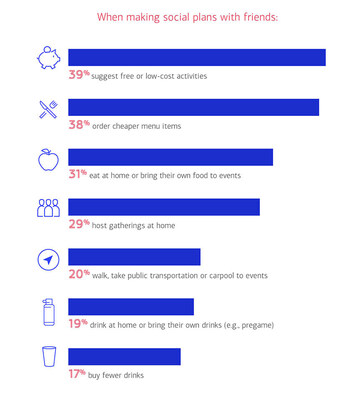
- 75% of Gen Z take active steps to save money when making social plans.
- 42% practice "loud budgeting," being vocal with friends about what social outings they can and cannot afford.
- 60% say they talk about money with their friends, covering historically taboo topics like salary (27%) and financial stress (24%).
- When asked what they'd do with an extra
$300 a month, more than half (54%) say they would put it straight into savings, outpacing Millennials (44%), Gen X (40%) and Baby Boomers (45%).
Little treats with a side of guilt
Gen Z hasn't given up on small indulgences. In fact, 92% treat themselves, and over half (52%) do so at least once a week, whether it be doughnuts or new sunglasses. At the same time, the spending remorse is real: 41% experience financial guilt at least once a week and 40% seek validation from family or friends before or after making a purchase. When it comes to priorities, 67% say they spend more on goods than experiences, and 19% say they'd choose material goods for themselves even if it means spending less on experiences with others.
About the 2026 Better Money Habits® Gen Z report
The annual study draws on Bank of America's Better Money Habits® financial education platform and proprietary survey data conducted by Ipsos. The research is based on a nationally representative sample of Gen Z adults (ages 18-29) across
The Bank of America Better Money Habits® platform supports Gen Z in building on positive habits by offering free financial education resources around budgets, setting goals and working toward long-term financial independence.
Methodology
This survey was conducted online from
The survey data has been weighted to match national population benchmarks. The general population sample and general population Gen Z sample were weighted separately to match national population demographics of gender, age, race/ethnicity, education, region, metropolitan status, household income, language proficiency and Hispanic origin. Benchmarks for these variables were obtained from the Census Bureau's 2025 Current Population Survey (CPS), with the exception of benchmarks for language proficiency, which were obtained from the Census Bureau's 2024 American Community Survey (ACS).
Better Money Habits
At Bank of America, we're committed to helping people lead better financial lives by equipping them with the skills, knowledge and confidence to succeed. That's why we created Better Money Habits, a financial education platform of tools and information that helps people make sense of their money and take action to improve. As a cornerstone of Better Money Habits, we offer free financial education content and tools, like our Gen Z Financial Guide that breaks down financial topics like budgeting, building credit, borrowing and investing in a way that's approachable and easy to understand. We continually look for ways to expand the reach of Better Money Habits and also offer Spanish language resources on the site.
Bank of America
Bank of America is one of the world's leading financial institutions, serving individual consumers, small and middle-market businesses and large corporations with a full range of banking, investing, asset management and other financial and risk management products and services. The company provides unmatched convenience in
For more Bank of America news, including dividend announcements and other important information, visit the Bank of America newsroom and register for news email alerts.
Reporters may contact
Phone: 1.646.743.0791
[email protected]
 View original content to download multimedia:https://www.prnewswire.com/news-releases/bofa-study-finds-fewer-gen-z-rely-on-family-for-financial-assistance-even-with-42-living-paycheck-to-paycheck-302776215.html
SOURCE Bank of America Corporation