


Deere Reports First-Quarter Income of $517 Million
- Net income rises 4% on 6% decline in net sales.
- U.S. farm sector shows early signs of stabilization.
- Full-year earnings forecast unchanged.
MOLINE, Ill., Feb. 21, 2020 /PRNewswire/ -- Deere & Company (NYSE: DE) reported net income of $517 million for the first quarter ended February 2, 2020, or $1.63 per share, compared with net income of $498 million, or $1.54 per share, for the quarter ended January 27, 2019. Worldwide net sales and revenues decreased 4 percent in the first quarter of 2020 to $7.631 billion. Net sales of the equipment operations were $6.530 billion for the quarter, compared with $6.941 billion in 2019.
"John Deere's first-quarter performance reflected early signs of stabilization in the U.S. farm sector," said John C. May, chief executive officer. "Farmer confidence, though still subdued, has improved due in part to hopes for a relaxation of trade tensions and higher agricultural exports. At the same time, activity in the construction sector has slowed leading to lower sales and profit for our Construction & Forestry division. Also impacting results in Deere's construction equipment business were our actions to reduce factory production and lower inventories in response to current market conditions. Additionally, the quarter included costs of a voluntary employee-separation program, which is among the steps Deere is taking to improve flexibility and efficiency."
Company Outlook & Summary
Net income attributable to Deere & Company for fiscal 2020 is forecast to be in a range of $2.7 billion to $3.1 billion.
"Looking ahead, we are particularly encouraged by the broad use of precision technologies and believe the company is well-positioned to strengthen its leadership in this vital area," May said. "In addition, we are proceeding with a series of measures to create a more focused organizational structure that can operate with greater speed and agility. These steps are leading to improved efficiencies and helping the company focus its resources and investments on areas that have the most impact on performance."
Deere & Company | First Quarter | |||||||
$ in millions | 2020 | 2019 | % Change | |||||
Net sales and revenues | $ | 7,631 | $ | 7,984 | -4% | |||
Net income | $ | 517 | $ | 498 | 4% | |||
Fully diluted EPS | $ | 1.63 | $ | 1.54 | ||||
The voluntary employee-separation program's total pretax expense recognized in the first quarter of 2020 was $127 million, with another $9 million to be recorded over the remainder of the year. Included in first-quarter expense was $22 million for items excluded from operating profit and $3 million recorded by financial services. Annual estimated savings from the separation program are approximately $85 million, with about $65 million expected in 2020. Discrete income tax benefits also affected the quarter's net income.
Equipment Operations | First Quarter | |||||||
$ in millions | 2020 | 2019 | % Change | |||||
Net sales | $ | 6,530 | $ | 6,941 | -6% | |||
Operating profit | $ | 466 | $ | 577 | -19% | |||
Net income | $ | 383 | $ | 340 | 13% | |||
For a discussion of net sales and operating profit results, see the Agriculture & Turf and Construction & Forestry sections below.
Agriculture & Turf | First Quarter | |||||||
$ in millions | 2020 | 2019 | % Change | |||||
Net sales | $ | 4,486 | $ | 4,681 | -4% | |||
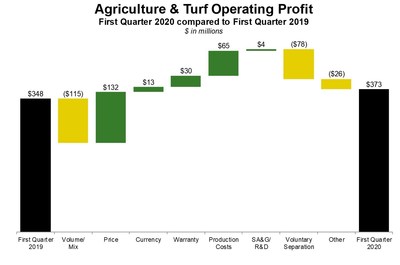
Operating profit | $ | 373 | $ | 348 | 7% | |||
Operating margin | 8.3% | 7.4% | ||||||
Agriculture & Turf sales for the quarter declined due to lower shipment volumes and the unfavorable effects of currency translation, partially offset by price realization. Operating profit increased primarily due to price realization, improved production costs, and lower warranty-related expenses, partially offset by lower shipment volumes / sales mix and voluntary employee-separation expenses.
Construction & Forestry | First Quarter | |||||||
$ in millions | 2020 | 2019 | % Change | |||||
Net sales | $ | 2,044 | $ | 2,260 | -10% | |||
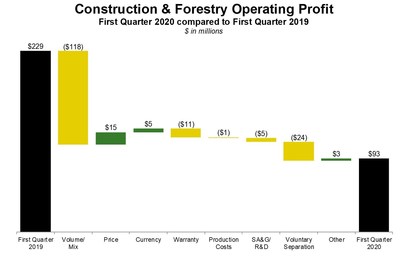
Operating profit | $ | 93 | $ | 229 | -59% | |||
Operating margin | 4.5% | 10.1% | ||||||
Construction & Forestry sales declined for the quarter due to lower shipment volumes and the unfavorable effects of currency translation, partially offset by price realization. Operating profit moved lower as a result of lower shipment volumes / sales mix and voluntary employee-separation expenses. These items were partially offset by price realization.
Financial Services | First Quarter | |||||||
$ in millions | 2020 | 2019 | % Change | |||||
Net income | $ | 137 | $ | 154 | -11% | |||
Financial services net income for the quarter decreased from the prior-year period. The decline was due primarily to higher losses on lease residual values, an increased provision for credit losses, prior-year favorable discrete adjustments to the provision for income taxes and greater selling, administrative and general expenses. These factors were partially offset by income earned on a higher average portfolio.
Market Conditions and Outlook (Annual) | Currency | Price | ||||
$ in millions | Net Sales | Translation | Realization | |||
Agriculture & Turf | -5% to -10% | -1% | 2% | |||
Construction & Forestry | -10% to -15% | -1% | 1% | |||
John Deere Financial | Net Income | $ 600 | ||||
Agriculture & Turf. Deere's worldwide sales of agriculture and turf equipment are forecast to decline 5 to 10 percent for fiscal-year 2020, including a negative currency-translation effect of about 1 percent. Industry sales of agricultural equipment in the U.S. and Canada are forecast to be down about 5 percent, driven by lower demand for large equipment in Canada. Full-year industry sales in Europe are forecast to be approximately flat as are South American industry sales of tractors and combines. Asian sales are forecast to be about the same as the prior year. Industry sales of turf and utility equipment in the U.S. and Canada are expected to be about flat.
Construction & Forestry. Deere's worldwide sales of construction and forestry equipment are anticipated to be down 10 to 15 percent for 2020, with foreign-currency rates having an unfavorable translation effect of about 1 percent. The outlook reflects slowing construction activity as well as efforts to bring down field inventory levels. Industry construction-equipment sales in North America are expected to decline by 5 to 10 percent for the year. In forestry, global industry sales are expected to be down 5 to 10 percent due to weaker demand in North America and Russia.
Financial Services. Full-year 2020 results are expected to benefit from lower losses on lease residual values and income earned from a higher average portfolio, partially offset by a higher provision for credit losses and prior-year favorable discrete adjustments to the provision for income taxes.
John Deere Capital Corporation
The following is disclosed on behalf of the company's financial services subsidiary, John Deere Capital Corporation (JDCC), in connection with the disclosure requirements applicable to its periodic issuance of debt securities in the public market.
First Quarter | ||||||||
$ in millions | 2020 | 2019 | % Change | |||||
Revenue | $ | 719 | $ | 661 | 9% | |||
Net income | $ | 99 | $ | 122 | -19% | |||
Ending portfolio balance | $ | 37,146 | $ | 34,975 | 6% | |||
Results for the quarter were lower than the same period in 2019 related to an increased provision for credit losses, higher losses on lease residual values, prior-year favorable discrete adjustments to the provision for income taxes, and greater selling, administrative and general expenses, partially offset by income earned on a higher average portfolio.
Safe Harbor Statement
Safe Harbor Statement under the Private Securities Litigation Reform Act of 1995: Statements under "Company Outlook & Summary," "Market Conditions & Outlook," and other forward-looking statements herein that relate to future events, expectations, and trends involve factors that are subject to change, and risks and uncertainties that could cause actual results to differ materially. Some of these risks and uncertainties could affect particular lines of business, while others could affect all of the company's businesses.
The company's agricultural equipment business is subject to a number of uncertainties including the factors that affect farmers' confidence and financial condition. These factors include demand for agricultural products, world grain stocks, weather conditions, soil conditions, harvest yields, prices for commodities and livestock, crop and livestock production expenses, availability of transport for crops, trade restrictions and tariffs (e.g., China), global trade agreements (e.g., the United States-Mexico-Canada Agreement), the level of farm product exports (including concerns about genetically modified organisms), the growth and sustainability of non-food uses for some crops (including ethanol and biodiesel production), real estate values, available acreage for farming, the land ownership policies of governments, changes in government farm programs and policies, international reaction to such programs, changes in and effects of crop insurance programs, changes in environmental regulations and their impact on farming practices, animal diseases (e.g., African swine fever) and their effects on poultry, beef and pork consumption and prices and on livestock feed demand, and crop pests and diseases.
Factors affecting the outlook for the company's turf and utility equipment include consumer confidence, weather conditions, customer profitability, labor supply, consumer borrowing patterns, consumer purchasing preferences, housing starts and supply, infrastructure investment, spending by municipalities and golf courses, and consumable input costs.
Consumer spending patterns, real estate and housing prices, the number of housing starts, interest rates and the levels of public and non-residential construction are important to sales and results of the company's construction and forestry equipment. Prices for pulp, paper, lumber and structural panels are important to sales of forestry equipment.
All of the company's businesses and its results are affected by general economic conditions in the global markets and industries in which the company operates; customer confidence in general economic conditions; government spending and taxing; foreign currency exchange rates and their volatility, especially fluctuations in the value of the U.S. dollar; interest rates (including the availability of IBOR reference rates); inflation and deflation rates; changes in weather patterns; the political and social stability of the global markets in which the company operates; the effects of, or response to, terrorism and security threats; wars and other conflicts; natural disasters; and the spread of major epidemics (including Coronavirus) and responses to epidemics such as government-imposed travel restrictions and extended shut down of businesses.
Significant changes in market liquidity conditions, changes in the company's credit ratings and any failure to comply with financial covenants in credit agreements could impact access to funding and funding costs, which could reduce the company's earnings and cash flows. Financial market conditions could also negatively impact customer access to capital for purchases of the company's products and customer confidence and purchase decisions, borrowing and repayment practices, and the number and size of customer loan delinquencies and defaults. A debt crisis, in Europe or elsewhere, could negatively impact currencies, global financial markets, social and political stability, funding sources and costs, asset and obligation values, customers, suppliers, demand for equipment, and company operations and results. The company's investment management activities could be impaired by changes in the equity, bond and other financial markets, which would negatively affect earnings.
The withdrawal of the United Kingdom from the European Union and the perceptions as to the impact of the withdrawal may adversely affect business activity, political stability and economic conditions in the United Kingdom, the European Union and elsewhere. The economic conditions and outlook could be further adversely affected by (i) uncertainty regarding any new or modified trade arrangements between the United Kingdom and the European Union and/or other countries, (ii) the risk that one or more other
European Union countries could come under increasing pressure to leave the European Union, or (iii) the risk that the euro as the single currency of the Eurozone could cease to exist. Any of these developments, or the perception that any of these developments are likely to occur, could affect economic growth or business activity in the United Kingdom or the European Union, and could result in the relocation of businesses, cause business interruptions, lead to economic recession or depression, and impact the stability of the financial markets, availability of credit, currency exchange rates, interest rates, financial institutions, and political, financial and monetary systems. Any of these developments could affect our businesses, liquidity, results of operations and financial position.
Additional factors that could materially affect the company's operations, access to capital, expenses and results include changes in, uncertainty surrounding and the impact of governmental trade, banking, monetary and fiscal policies, including financial regulatory reform and its effects on the consumer finance industry, derivatives, funding costs and other areas, and governmental programs, policies, tariffs and sanctions in particular jurisdictions or for the benefit of certain industries or sectors; retaliatory actions to such changes in trade, banking, monetary and fiscal policies; actions by central banks; actions by financial and securities regulators; actions by environmental, health and safety regulatory agencies, including those related to engine emissions, carbon and other greenhouse gas emissions, noise and the effects of climate change; changes to GPS radio frequency bands or their permitted uses; changes in labor and immigration regulations; changes to accounting standards; changes in tax rates, estimates, laws and regulations and company actions related thereto; changes to and compliance with privacy regulations; compliance with U.S. and foreign laws when expanding to new markets and otherwise; and actions by other regulatory bodies.
Other factors that could materially affect results include production, design and technological innovations and difficulties, including capacity and supply constraints and prices; the loss of or challenges to intellectual property rights whether through theft, infringement, counterfeiting or otherwise; the availability and prices of strategically sourced materials, components and whole goods; delays or disruptions in the company's supply chain or the loss of liquidity by suppliers; disruptions of infrastructures that support communications, operations or distribution; the failure of suppliers or the company to comply with laws, regulations and company policy pertaining to employment, human rights, health, safety, the environment, anti-corruption, privacy and data protection and other ethical business practices; events that damage the company's reputation or brand; significant investigations, claims, lawsuits or other legal proceedings; start-up of new plants and products; the success of new product initiatives; changes in customer product preferences and sales mix; gaps or limitations in rural broadband coverage, capacity and speed needed to support technology solutions; oil and energy prices, supplies and volatility; the availability and cost of freight; actions of competitors in the various industries in which the company competes, particularly price discounting; dealer practices especially as to levels of new and used field inventories; changes in demand and pricing for used equipment and resulting impacts on lease residual values; labor relations and contracts; changes in the ability to attract, train and retain qualified personnel; acquisitions and divestitures of businesses; greater than anticipated transaction costs; the integration of new businesses; the failure or delay in closing or realizing anticipated benefits of acquisitions, joint ventures or divestitures; the implementation of organizational changes; the failure to realize anticipated savings or benefits of cost reduction, productivity, or efficiency efforts; difficulties related to the conversion and implementation of enterprise resource planning systems; security breaches, cybersecurity attacks, technology failures and other disruptions to the company's and suppliers' information technology infrastructure; changes in company declared dividends and common stock issuances and repurchases; changes in the level and funding of employee retirement benefits; changes in market values of investment assets, compensation, retirement, discount and mortality rates which impact retirement benefit costs; and significant changes in health care costs.
The liquidity and ongoing profitability of John Deere Capital Corporation and other credit subsidiaries depend largely on timely access to capital in order to meet future cash flow requirements, and to fund operations, costs, and purchases of the company's products. If general economic conditions deteriorate or capital markets become more volatile, funding could be unavailable or insufficient. Additionally, customer confidence levels may result in declines in credit applications and increases in delinquencies and default rates, which could materially impact write-offs and provisions for credit losses.
The company's outlook is based upon assumptions relating to the factors described above, which are sometimes based upon estimates and data prepared by government agencies. Such estimates and data are often revised. The company, except as required by law, undertakes no obligation to update or revise its outlook, whether as a result of new developments or otherwise. Further information concerning the company and its businesses, including factors that could materially affect the company's financial results, is included in the company's other filings with the SEC (including, but not limited to, the factors discussed in Item 1A. Risk Factors of the company's most recent annual report on Form 10-K and quarterly reports on Form 10-Q).
First Quarter 2020 Press Release | |||||||||
(in millions of dollars) | |||||||||
Unaudited | |||||||||
Three Months Ended | |||||||||
February 2 | January 27 | % | |||||||
2020 | 2019 | Change | |||||||
Net sales and revenues: | |||||||||
Agriculture and turf | $ | 4,486 | $ | 4,681 | -4 | ||||
Construction and forestry | 2,044 | 2,260 | -10 | ||||||
Total net sales | 6,530 | 6,941 | -6 | ||||||
Financial services | 931 | 855 | +9 | ||||||
Other revenues | 170 | 188 | -10 | ||||||
Total net sales and revenues | $ | 7,631 | $ | 7,984 | -4 | ||||
Operating profit: * | |||||||||
Agriculture and turf | $ | 373 | $ | 348 | +7 | ||||
Construction and forestry | 93 | 229 | -59 | ||||||
Financial services | 179 | 192 | -7 | ||||||
Total operating profit | 645 | 769 | -16 | ||||||
Reconciling items ** | (78) | (87) | -10 | ||||||
Income taxes | (50) | (184) | -73 | ||||||
Net income attributable to Deere & Company | $ | 517 | $ | 498 | +4 | ||||
* | Operating profit is income from continuing operations before corporate expenses, certain external interest expense, certain foreign exchange gains and losses, and income taxes. Operating profit of the financial services segment includes the effect of interest expense and foreign exchange gains or losses. |
** | Reconciling items are primarily corporate expenses, certain external interest expense, certain foreign exchange gains and losses, pension and postretirement benefit costs excluding the service cost component, and net income attributable to noncontrolling interests. |
DEERE & COMPANY | ||||||
STATEMENT OF CONSOLIDATED INCOME | ||||||
For the Three Months Ended February 2, 2020 and January 27, 2019 | ||||||
(In millions of dollars and shares except per share amounts) Unaudited | ||||||
2020 | 2019 | |||||
Net Sales and Revenues | ||||||
Net sales | $ | 6,530 | $ | 6,941 | ||
Finance and interest income | 896 | 815 | ||||
Other income | 205 | 228 | ||||
Total | 7,631 | 7,984 | ||||
Costs and Expenses | ||||||
Cost of sales | 5,077 | 5,432 | ||||
Research and development expenses | 425 | 407 | ||||
Selling, administrative and general expenses | 809 | 764 | ||||
Interest expense | 336 | 353 | ||||
Other operating expenses | 415 | 351 | ||||
Total | 7,062 | 7,307 | ||||
Income of Consolidated Group before Income Taxes | 569 | 677 | ||||
Provision for income taxes | 50 | 184 | ||||
Income of Consolidated Group | 519 | 493 | ||||
Equity in income (loss) of unconsolidated affiliates | (1) | 7 | ||||
Net Income | 518 | 500 | ||||
Less: Net income attributable to noncontrolling interests | 1 | 2 | ||||
Net Income Attributable to Deere & Company | $ | 517 | $ | 498 | ||
Per Share Data | ||||||
Basic | $ | 1.65 | $ | 1.56 | ||
Diluted | $ | 1.63 | $ | 1.54 | ||
Average Shares Outstanding | ||||||
Basic | 313.5 | 318.5 | ||||
Diluted | 317.2 | 322.7 | ||||
See Condensed Notes to Interim Consolidated Financial Statements. | ||||||
DEERE & COMPANY | |||||||||
CONDENSED CONSOLIDATED BALANCE SHEET | |||||||||
(In millions of dollars) Unaudited | |||||||||
February 2 | November 3 | January 27 | |||||||
2020 | 2019 | 2019 | |||||||
Assets | |||||||||
Cash and cash equivalents | $ | 3,602 | $ | 3,857 | $ | 3,626 | |||
Marketable securities | 609 | 581 | 523 | ||||||
Receivables from unconsolidated affiliates | 38 | 46 | 36 | ||||||
Trade accounts and notes receivable - net | 5,360 | 5,230 | 5,497 | ||||||
Financing receivables - net | 27,294 | 29,195 | 25,150 | ||||||
Financing receivables securitized - net | 4,478 | 4,383 | 4,563 | ||||||
Other receivables | 1,367 | 1,487 | 1,651 | ||||||
Equipment on operating leases - net | 7,504 | 7,567 | 6,904 | ||||||
Inventories | 6,482 | 5,975 | 7,402 | ||||||
Property and equipment - net | 5,900 | 5,973 | 5,785 | ||||||
Investments in unconsolidated affiliates | 217 | 215 | 212 | ||||||
Goodwill | 2,945 | 2,917 | 3,048 | ||||||
Other intangible assets - net | 1,349 | 1,380 | 1,507 | ||||||
Retirement benefits | 900 | 840 | 1,348 | ||||||
Deferred income taxes | 1,414 | 1,466 | 834 | ||||||
Other assets | 2,362 | 1,899 | 1,832 | ||||||
Total Assets | $ | 71,821 | $ | 73,011 | $ | 69,918 | |||
Liabilities and Stockholders' Equity | |||||||||
Liabilities | |||||||||
Short-term borrowings | $ | 10,008 | $ | 10,784 | $ | 10,738 | |||
Short-term securitization borrowings | 4,416 | 4,321 | 4,464 | ||||||
Payables to unconsolidated affiliates | 147 | 142 | 144 | ||||||
Accounts payable and accrued expenses | 8,630 | 9,656 | 9,086 | ||||||
Deferred income taxes | 491 | 495 | 525 | ||||||
Long-term borrowings | 30,475 | 30,229 | 27,855 | ||||||
Retirement benefits and other liabilities | 5,710 | 5,953 | 5,759 | ||||||
Total liabilities | 59,877 | 61,580 | 58,571 | ||||||
Redeemable noncontrolling interest | 14 | 14 | 14 | ||||||
Stockholders' Equity | |||||||||
Total Deere & Company stockholders' equity | 11,926 | 11,413 | 11,328 | ||||||
Noncontrolling interests | 4 | 4 | 5 | ||||||
Total stockholders' equity | 11,930 | 11,417 | 11,333 | ||||||
Total Liabilities and Stockholders' Equity | $ | 71,821 | $ | 73,011 | $ | 69,918 | |||
See Condensed Notes to Interim Consolidated Financial Statements. | |||||||||
DEERE & COMPANY | ||||||
STATEMENT OF CONSOLIDATED CASH FLOWS | ||||||
For the Three Months Ended February 2, 2020 and January 27, 2019 | ||||||
(In millions of dollars) Unaudited | ||||||
2020 | 2019 | |||||
Cash Flows from Operating Activities | ||||||
Net income | $ | 518 | $ | 500 | ||
Adjustments to reconcile net income to net cash used for operating activities: | ||||||
Provision for credit losses | 15 | 2 | ||||
Provision for depreciation and amortization | 538 | 503 | ||||
Share-based compensation expense | 19 | 20 | ||||
Undistributed earnings of unconsolidated affiliates | (7) | |||||
Credit for deferred income taxes | (29) | (56) | ||||
Changes in assets and liabilities: | ||||||
Trade, notes and financing receivables related to sales | 70 | (507) | ||||
Inventories | (642) | (1,396) | ||||
Accounts payable and accrued expenses | (1,134) | (698) | ||||
Accrued income taxes payable/receivable | (53) | 98 | ||||
Retirement benefits | 36 | (4) | ||||
Other | 154 | (106) | ||||
Net cash used for operating activities | (508) | (1,651) | ||||
Cash Flows from Investing Activities | ||||||
Collections of receivables (excluding receivables related to sales) | 5,664 | 5,496 | ||||
Proceeds from maturities and sales of marketable securities | 18 | 8 | ||||
Proceeds from sales of equipment on operating leases | 426 | 371 | ||||
Cost of receivables acquired (excluding receivables related to sales) | (4,303) | (4,213) | ||||
Purchases of marketable securities | (34) | (32) | ||||
Purchases of property and equipment | (271) | (297) | ||||
Cost of equipment on operating leases acquired | (517) | (361) | ||||
Other | 43 | (3) | ||||
Net cash provided by investing activities | 1,026 | 969 | ||||
Cash Flows from Financing Activities | ||||||
Increase (decrease) in total short-term borrowings | (473) | 476 | ||||
Proceeds from long-term borrowings | 1,702 | 2,211 | ||||
Payments of long-term borrowings | (1,651) | (1,941) | ||||
Proceeds from issuance of common stock | 53 | 51 | ||||
Repurchases of common stock | (114) | (144) | ||||
Dividends paid | (242) | (220) | ||||
Other | (38) | (30) | ||||
Net cash provided by (used for) financing activities | (763) | 403 | ||||
Effect of Exchange Rate Changes on Cash, Cash Equivalents, and Restricted Cash | (1) | (13) | ||||
Net Decrease in Cash, Cash Equivalents, and Restricted Cash | (246) | (292) | ||||
Cash, Cash Equivalents, and Restricted Cash at Beginning of Period | 3,956 | 4,015 | ||||
Cash, Cash Equivalents, and Restricted Cash at End of Period | $ | 3,710 | $ | 3,723 | ||
See Condensed Notes to Interim Consolidated Financial Statements. | ||||||
Condensed Notes to Interim Consolidated Financial Statements (Unaudited) | |||||||
(1) | During the first quarter of 2020, the Company announced a broad voluntary employee-separation program for the U.S. salaried workforce that continues the efforts to create a more efficient organization structure and reduce operating costs. The program provided for cash payments based on years of service. The expense was recorded primarily in the period in which the employees irrevocably accepted the separation offer. The program's total estimated pretax expenses are approximately $136 million, of which $127 million was recorded in the first quarter. The payments for the program were substantially made in the first quarter of 2020. Included in the total pretax expense is a non-cash charge of $21 million resulting from a curtailment in certain OPEB plans, which will be recorded outside of operating profit in "Other operating expense." The first quarter 2020 expenses that are included in operating profit of $105 million are allocated 37 percent "Cost of sales," 15 percent "Research and development," and 48 percent "Selling, administrative and general." In addition, the expenses are allocated 75 percent to the agriculture and turf operations, 23 percent to the construction and forestry operations, and 2 percent to the financial services operations. Annual savings from this program are estimated to be approximately $85 million with about $65 million in 2020. | ||||||
(2) | Dividends declared and paid on a per share basis were as follows: | ||||||
Three Months Ended | |||||||
February 2 | January 27 | ||||||
2020 | 2019 | ||||||
Dividends declared | $ | .76 | $ | .76 | |||
Dividends paid | $ | .76 | $ | .69 | |||
(3) | The calculation of basic net income per share is based on the average number of shares outstanding. The calculation of diluted net income per share recognizes any dilutive effect of share-based compensation. | ||||||
(4) | The consolidated financial statements represent the consolidation of all Deere & Company's subsidiaries. In the supplemental consolidating data in Note 5 to the financial statements, "Equipment Operations" include the Company's agriculture and turf operations and construction and forestry operations with "Financial Services" reflected on the equity basis. | ||||||
(5) SUPPLEMENTAL CONSOLIDATING DATA | ||||||||||||
STATEMENT OF INCOME | ||||||||||||
For the Three Months Ended February 2, 2020 and January 27, 2019 | ||||||||||||
(In millions of dollars) Unaudited | EQUIPMENT OPERATIONS* | FINANCIAL SERVICES | ||||||||||
2020 | 2019 | 2020 | 2019 | |||||||||
Net Sales and Revenues | ||||||||||||
Net sales | $ | 6,530 | $ | 6,941 | ||||||||
Finance and interest income | 27 | 23 | $ | 936 | $ | 866 | ||||||
Other income | 209 | 215 | 62 | 60 | ||||||||
Total | 6,766 | 7,179 | 998 | 926 | ||||||||
Costs and Expenses | ||||||||||||
Cost of sales | 5,078 | 5,432 | ||||||||||
Research and development expenses | 425 | 407 | ||||||||||
Selling, administrative and general expenses | 672 | 645 | 138 | 121 | ||||||||
Interest expense | 63 | 71 | 275 | 287 | ||||||||
Interest compensation to Financial Services | 64 | 69 | ||||||||||
Other operating expenses | 72 | 71 | 408 | 325 | ||||||||
Total | 6,374 | 6,695 | 821 | 733 | ||||||||
Income of Consolidated Group before Income Taxes | 392 | 484 
| 177 | 193 | ||||||||
Provision for income taxes | 9 | 144 | 41 | 40 | ||||||||
Income of Consolidated Group | 383 | 340 | 136 | 153 | ||||||||
Equity in Income (Loss) of Unconsolidated Subsidiaries and Affiliates | ||||||||||||
Financial Services | 137 | 154 | 1 | 1 | ||||||||
Other | (2) | 6 | ||||||||||
Total | 135 | 160 | 1 | 1 | ||||||||
Net Income | 518 | 500 | 137 | 154 | ||||||||
Less: Net income attributable to noncontrolling interests | 1 | 2 | ||||||||||
Net Income Attributable to Deere & Company | $ | 517 | $ | 498 | $ | 137 | $ | 154 | ||||
* Deere & Company with Financial Services on the equity basis. | ||||||||||||
The supplemental consolidating data is presented for informational purposes. Transactions between the "Equipment Operations" and "Financial Services" have been eliminated to arrive at the consolidated financial statements. | ||||||||||||
SUPPLEMENTAL CONSOLIDATING DATA (Continued) | ||||||||||||||||||
CONDENSED BALANCE SHEET | ||||||||||||||||||
(In millions of dollars) Unaudited | EQUIPMENT OPERATIONS* | FINANCIAL SERVICES | ||||||||||||||||
February 2 | November 3 | January 27 | February 2 | November 3 | January 27 | |||||||||||||
2020 | 2019 | 2019 | 2020 | 2019 | 2019 | |||||||||||||
Assets | ||||||||||||||||||
Cash and cash equivalents | $ | 2,862 | $ | 3,175 | $ | 2,671 | $ | 740 | $ | 682 | $ | 955 | ||||||
Marketable securities | 4 | 1 | 8 | 605 | 580 | 515 | ||||||||||||
Receivables from unconsolidated subsidiaries and affiliates | 1,425 | 2,017 | 274 | |||||||||||||||
Trade accounts and notes receivable - net | 1,115 | 1,482 | 1,177 | 5,707 | 5,153 | 5,746 | ||||||||||||
Financing receivables - net | 130 | 65 | 102 | 27,164 | 29,130 | 25,048 | ||||||||||||
Financing receivables securitized - net | 42 | 44 | 67 | 4,436 | 4,339 | 4,496 | ||||||||||||
Other receivables | 1,252 | 1,376 | 1,485 | 131 | 116 | 184 | ||||||||||||
Equipment on operating leases - net | 7,504 | 7,567 | 6,904 | |||||||||||||||
Inventories | 6,482 | 5,975 | 7,402 | |||||||||||||||
Property and equipment - net | 5,857 | 5,929 | 5,739 | 43 | 44 | 46 | ||||||||||||
Investments in unconsolidated subsidiaries and affiliates | 5,317 | 5,326 | 5,175 | 17 | 16 | 16 | ||||||||||||
Goodwill | 2,945 | 2,917 | 3,048 | |||||||||||||||
Other intangible assets - net | 1,349 | 1,380 | 1,507 | |||||||||||||||
Retirement benefits | 871 | 836 | 1,291 | 58 | 58 | 57 | ||||||||||||
Deferred income taxes | 1,821 | 1,896 | 1,507 | 56 | 57 | 70 | ||||||||||||
Other assets | 1,546 | 1,158 | 1,241 | 818 | 741 | 593 | ||||||||||||
Total Assets | $ | 33,018 | $ | 33,577 | $ | 32,694 | $ | 47,279 | $ | 48,483 | $ | 44,630 | ||||||
Liabilities and Stockholders' Equity | ||||||||||||||||||
Liabilities | ||||||||||||||||||
Short-term borrowings | $ | 947 | $ | 987 | $ | 1,494 | $ | 9,061 | $ | 9,797 | $ | 9,244 | ||||||
Short-term securitization borrowings | 42 | 44 | 67 | 4,374 | 4,277 | 4,397 | ||||||||||||
Payables to unconsolidated subsidiaries and affiliates | 146 | 142 | 227 | 1,387 | 1,970 | 155 | ||||||||||||
Accounts payable and accrued expenses | 8,325 | 9,232 | 8,711 | 1,786 | 1,836 | 1,821 | ||||||||||||
Deferred income taxes | 408 | 414 | 470 | 546 | 568 | 798 | ||||||||||||
Long-term borrowings | 5,567 | 5,415 | 4,712 | 24,908 | 24,814 | 23,143 | ||||||||||||
Retirement benefits and other liabilities | 5,639 | 5,912 | 5,666 | 100 | 94 | 93 | ||||||||||||
Total liabilities | 21,074 | 22,146 | 21,347 | 42,162 | 43,356 | 39,651 | ||||||||||||
Redeemable noncontrolling interest | 14 | 14 | 14 | |||||||||||||||
Stockholders' Equity | ||||||||||||||||||
Total Deere & Company stockholders' equity | 11,926 | 11,413 | 11,328 | 5,117 | 5,127 | 4,979 | ||||||||||||
Noncontrolling interests | 4 | 4 | 5 | |||||||||||||||
Total stockholders' equity | 11,930 | 11,417 | 11,333 | 5,117 | 5,127 | 4,979 | ||||||||||||
Total Liabilities and Stockholders' Equity | $ | 33,018 | $ | 33,577 | $ | 32,694 | $ | 47,279 | $ | 48,483 | $ | 44,630 | ||||||
* Deere & Company with Financial Services on the equity basis. | ||||||||||||||||||
The supplemental consolidating data is presented for informational purposes. Transactions between the "Equipment Operations" and "Financial Services" have been eliminated to arrive at the consolidated financial statements. | ||||||||||||||||||
SUPPLEMENTAL CONSOLIDATING DATA (Continued) | ||||||||||||
STATEMENT OF CASH FLOWS | ||||||||||||
For the Three Months Ended February 2, 2020 and January 27, 2019 | ||||||||||||
(In millions of dollars) Unaudited | EQUIPMENT OPERATIONS* | FINANCIAL SERVICES | ||||||||||
2020 | 2019 | 2020 | 2019 | |||||||||
Cash Flows from Operating Activities | ||||||||||||
Net income | $ | 518 | $ | 500 | $ | 137 | $ | 154 | ||||
Adjustments to reconcile net income to net cash provided by (used for) operating activities: | ||||||||||||
Provision (credit) for credit losses | 1 | (1) | 14 | 3 | ||||||||
Provision for depreciation and amortization | 261 | 260 | 311 | 276 | ||||||||
Undistributed earnings of unconsolidated subsidiaries and affiliates | (11) | 39 | (1) | |||||||||
Credit for deferred income taxes | (7) | (31) | (22) | (25) | ||||||||
Changes in assets and liabilities: | ||||||||||||
Trade receivables and Equipment Operations' financing receivables | 312 | 186 | ||||||||||
Inventories | (530) | (1,290) | ||||||||||
Accounts payable and accrued expenses | (1,058) | (535) | (19) | (12) | ||||||||
Accrued income taxes payable/receivable | (43) | (429) | (10) | 527 | ||||||||
Retirement benefits | 30 | (6) | 6 | 2 | ||||||||
Other | 147 | (127) | 30 | 47 | ||||||||
Net cash provided by (used for) operating activities | (380) | (1,434) | 446 | 972 | ||||||||
Cash Flows from Investing Activities | ||||||||||||
Collections of receivables (excluding trade and wholesale) | 6,056 | 5,885 | ||||||||||
Proceeds from maturities and sales of marketable securities | 3 | 18 | 5 | |||||||||
Proceeds from sales of equipment on operating leases | 426 | 371 | ||||||||||
Cost of receivables acquired (excluding trade and wholesale) | (4,569) | (4,448) | ||||||||||
Purchases of marketable securities | (2) | (34) | (30) | |||||||||
Purchases of property and equipment | (271) | (297) | ||||||||||
Cost of equipment on operating leases acquired | (669) | (505) | ||||||||||
Increase in trade and wholesale receivables | (382) | (1,021) | ||||||||||
Other | (9) | (6) | 11 | 26 | ||||||||
Net cash provided by (used for) investing activities | (280) | (302) | 857 | 283 | ||||||||
Cash Flows from Financing Activities | ||||||||||||
Increase (decrease) in total short-term borrowings | 20 | 88 | (493) | 388 | ||||||||
Change in intercompany receivables/payables | 572 | 1,526 | (572) | (1,526) | ||||||||
Proceeds from long-term borrowings | 167 | 91 | 1,535 | 2,120 | ||||||||
Payments of long-term borrowings | (83) | (142) | (1,568) | (1,799) | ||||||||
Proceeds from issuance of common stock | 53 | 51 | ||||||||||
Repurchases of common stock | (114) | (144) | ||||||||||
Dividends paid | (242) | (220) | (125) | (200) | ||||||||
Other | (29) | (23) | (9) | (8) | ||||||||
Net cash provided by (used for) financing activities | 344 | 1,227 | (1,232) | (1,025) | ||||||||
Effect of Exchange Rate Changes on Cash, Cash Equivalents, and Restricted Cash | 3 | (12) | (4) | (1) | ||||||||
Net Increase (Decrease) in Cash, Cash Equivalents, and Restricted Cash | (313) | (521) | 67 | 229 | ||||||||
Cash, Cash Equivalents, and Restricted Cash at Beginning of Period | 3,196 | 3,202 | 760 | 813 | ||||||||
Cash, Cash Equivalents, and Restricted Cash at End of Period | $ | 2,883 | $ | 2,681 | $ | 827 | $ | 1,042 | ||||
* Deere & Company with Financial Services on the equity basis. | ||||||||||||
The supplemental consolidating data is presented for informational purposes. Transactions between the "Equipment Operations" and "Financial Services" have been eliminated to arrive at the consolidated financial statements. | ||||||||||||
Deere & Company | |||||||||||||||||||
Other Financial Information | |||||||||||||||||||
For the Three Months Ended | Equipment Operations* | Agriculture and Turf | Construction and Forestry* | ||||||||||||||||
February 2 | January 27 | February 2 | January 27 | February 2 | January 27 | ||||||||||||||
Dollars in millions | 2020 | 2019 | 2020 | 2019 | 2020 | 2019 | |||||||||||||
Net Sales | $ | 6,530 | $ | 6,941 | $ | 4,486 | $ | 4,681 | $ | 2,044 | $ | 2,260 | |||||||
Net Sales - excluding Roadbuilding | $ | 5,925 | $ | 6,343 | $ | 4,486 | $ | 4,681 | $ | 1,439 | $ | 1,662 | |||||||
Average Identifiable Assets | |||||||||||||||||||
With Inventories at LIFO | $ | 20,197 | $ | 20,774 | $ | 10,782 | $ | 10,892 | $ | 9,415 | $ | 9,882 | |||||||
With Inventories at LIFO - excluding Roadbuilding | $ | 14,237 | $ | 14,427 | $ | 10,782 | $ | 10,892 | $ | 3,455 | $ | 3,535 | |||||||
With Inventories at Standard Cost | $ | 21,615 | $ | 22,140 | $ | 11,932 | $ | 11,993 | $ | 9,683 | $ | 10,147 | |||||||
With Inventories at Standard Cost - excluding Roadbuilding | $ | 15,655 | $ | 15,793 | $ | 11,932 | $ | 11,993 | $ | 3,723 | $ | 3,800 | |||||||
Operating Profit | $ | 466 | $ | 577 | $ | 373 | $ | 348 | $ | 93 | $ | 229 | |||||||
Operating Profit - excluding Roadbuilding | $ | 449 | $ | 563 | $ | 373 | $ | 348 | $ | 76 | $ | 215 | |||||||
Percent of Net Sales - excluding Roadbuilding | 7.6 | % | 8.9 | % | 8.3 | % | 7.4 | % | 5.3 | % | 12.9 | % | |||||||
Operating Return on Assets - excluding Roadbuilding | |||||||||||||||||||
With Inventories at LIFO - excluding Roadbuilding | 3.2 | % | 3.9 | % | 3.5 | % | 3.2 | % | 2.2 | % | 6.1 | % | |||||||
With Inventories at Standard Cost - excluding Roadbuilding | 2.9 | % | 3.6 | % | 3.1 | % | 2.9 | % | 2.0 | % | 5.7 | % | |||||||
SVA Cost of Assets | $ | (470) | $ | (474) | $ | (358) | $ | (360) | $ | (112) | $ | (114) | |||||||
SVA | $ | (21) | $ | 89 | $ | 15 | $ | (12) | $ | (36) | $ | 101 | |||||||
For the Three Months Ended | Financial Services | ||||||||||||||||||
February 2 | January 27 | ||||||||||||||||||
Dollars in millions | 2020 | 2019 | |||||||||||||||||
Net Income Attributable to Deere & Company | $ | 137 | $ | 154 | |||||||||||||||
Average Equity | $ | 5,119 | $ | 4,997 | |||||||||||||||
Return on Equity | 2.7 | % | 3.1 | % | |||||||||||||||
Operating Profit | $ | 179 | $ | 192 | |||||||||||||||
Cost of Equity | $ | (166) | $ | (156) | |||||||||||||||
SVA | $ | 13 | $ | 36 | |||||||||||||||
The Company evaluates its business results on the basis of accounting principles generally accepted in the United States. In addition, it uses a metric referred to as Shareholder Value Added (SVA), which management believes is an appropriate measure for the performance of its businesses. SVA is, in effect, the pretax profit left over after subtracting the cost of enterprise capital. The Company is aiming for a sustained creation of SVA and is using this metric for various performance goals. Certain compensation is also determined on the basis of performance using this measure. For purposes of determining SVA, each of the equipment segments is assessed a pretax cost of assets, which on an annual basis is approximately 12 percent of the segment's average identifiable operating assets during the applicable period with inventory at standard cost. Management believes that valuing inventories at standard cost more closely approximates the current cost of inventory and the Company's investment in the asset. The Financial Services segment is assessed an annual pretax cost of approximately 13 percent of the segment's average equity. The cost of assets or equity, as applicable, is deducted from the operating profit or added to the operating loss of each segment to determine the amount of SVA. * The results and assets related to the Company's Roadbuilding product line are excluded from the calculation of SVA to allow time for integration and assimilation of the 2017 acquisition of Wirtgen Group Holding GmbH's operations. | |||||||||||||||||||
 View original content to download multimedia:http://www.prnewswire.com/news-releases/deere-reports-first-quarter-income-of-517-million-301008918.html
SOURCE Deere & Company